Showing posts with label IFRS 16. Show all posts

Monday, 9 March 2020

Impact of MFRS 16 on AirAsia Group Bhd

Disclaimer: The content in this blog post contains my own opinion and it should not be relied upon for making any decisions.

Recently, while I was browsing Facebook, I saw this news by The Borneo Post Online in Facebook:

AirAsia Group Bhd slipped into the red with a net loss of RM303.72 million for the financial year ended Dec 31, 2019 (FY19) compared with a net profit of RM1.97 billion in the preceding year.
Posted by Borneo Post Online on Thursday, February 27, 2020


According to the news, the reasons for AirAsia Group Bhd to suffer net loss in the financial year 2019 were partly due to the following:
"The weaker bottom-line, despite a 17 per cent jump in revenue to RM12.45 billion, was partly attributed to accounting treatment of the restructured aircraft ownership, moving from owning to leasing aircraft, despite recording similar cash outflow in either financing method, the low-cost airline said."
"According to the company, the adoption of Malaysian Financial Reporting Standard (MFRS) 16 reduced its net operating profit by RM130.9 million while the MFRS 137 accounting treatment led to a 43 per cent jump in maintenance and overhaul costs."
"The airline’s bottom-line was partly weighed down by a depreciation of right-of-use assets of RM1.76 billion and finance costs (lease liabilities) of RM505.87 million following the adoption of MFRS 16."
I thought it will be interesting to analyse the accounting treatments in this news as it will be relevant to ACCA students (especially SBR students as it will be good for you to apply what you learnt in the class to the actual business world). Hence, I write this post which contains my opinion on the impact of the above accounting treatments.

IFRS 16 Treatment


According to IFRS 16 Leases, when an entity leases an asset, the entity is required to recognise a right-of-use asset and a lease liability.

Generally, the right-of-use asset will be depreciated whereas finance cost will be recognised on lease liability.

This is in contrast with the previous IAS 17 Leases where an entity may have finance lease and operating lease. The accounting treatment of finance lease is similar to the current IFRS 16 treatment (hence there isn't much impact for finance lease under IFRS 16). However, for operating lease, the treatment was to expense off the lease payment in Statement of Profit or Loss (SOPL).

Refer to the table below for a comparison between IAS 17's operating lease and IFRS 16's treatment:


IAS 17 Operating Lease
IFRS 16
Expenses 
Lease payment 
(rental paid)
Depreciation of right-of-use asset
Finance cost on lease liability
Asset
None
Right-of-use asset
Liability
None
Lease liability

As we can see from the above, under IFRS 16, the entity may have potentially more expenses as well as having a higher asset and liability figure.

Let's have a look at AirAsia's recent fourth quarter report ended 31 December 2019 (the relevant results are summarised in the table below):


Cumulative

Year Ended
31/12/2019
RM’000
Year Ended
31/12/2018
RM’000
Aircraft operating lease expenses
-
(1,155,680)
Depreciation of right of use asset
(1,762,663)
-
Finance costs - lease liabilities
(505,873)
-

Total expenses related to IFRS 16 / IAS 17
(2,268,536)
(1,155,680)

As we can see from the above, there have been around 96% increase in the expenses once IFRS 16 is adopted.


Whereas for the increase in right-of-use asset and lease liability:


As At
31/12/2019
RM’000
As At
31/12/2018
RM’000
Right of use assets
12,219,457
-


Lease liabilities – current liabilities
2,104,702
-
Lease liabilities – non-current liabilities
10,156,869


A full 100% increase. 

However, it should be noted that AirAsia Group Bhd did not apply full retrospective adjustment under IAS 8. It was mentioned in the notes to the unaudited financial statements that:
"On the date of initial application (of MFRS 16), the Group applied the simplified transition approach and did not restate comparative amounts for the period prior to first adoption."
In any case, with the increase in right-of-use assets (i.e. increase in capital employed), the return on capital employed (ROCE) of the company will definitely be impacted (i.e. reduced).

Not only that, the lease liabilities will also increase the gearing ratio of the company.

As such, we can now see that IFRS 16 might cause some impact on the financial statements which might be perceived as negative as investors (despite the fact that all these are just accounting adjustments).

Restructured Aircraft Ownership

Next, we shall explore the issue on the restructuring in the aircraft ownership of AirAsia Group Bhd. In the news, it was mentioned that the company was "moving from owning to leasing aircraft".

To understand this, it is necessary for us to understand what was happening to AirAsia Group Bhd in the year 2019. Let's look at one news on AirAsia in year 2019:

The company plans to fully shift to the new model by completely withdrawing from aircraft ownership.
Posted by The Star on Sunday, June 2, 2019


In short, AirAsia Group Bhd had decided to went into sales and leaseback agreements.

Image from IFRS Box.
Note: I have written the accounting treatment of sales and leaseback agreement previously. You can read more at the link below if you are interested to know more:

1. https://tysonspeaks.blogspot.com/2019/08/ifrs-16-sales-and-leaseback-part-1.html
2. https://tysonspeaks.blogspot.com/2019/08/ifrs-16-sales-and-leaseback-part-2.html

Borneo Post had mentioned that "MFRS 137 accounting treatment led to a 43 per cent jump in maintenance and overhaul costs". MFRS 137 is similar to IAS 37 Provisions, Contingent Liabilities and Contingent Assets.

If you look into AirAsia's recent fourth quarter report ended 31 December 2019, you will realise the following:


Cumulative

Year Ended
31/12/2019
RM’000
Year Ended
31/12/2018
RM’000
Maintenance and overhaul
(1,320,820)
(938,369)

An increase of around 41% in expense, which is similar to what was being reported in Borneo Post.

In relation to the provision balance we see that provision balance has also increased, as shown below:


As At
31/12/2019
RM’000
As at
31/12/2018
RM’000
Aircraft maintenance provisions / payables


-          Current liabilities
1,861,748
878,941
-          Non-current liabilities
3,547,776
4,049,068
Total
5,409,524
4,928,009

According to the notes to the unaudited financial statements, it is mentioned that:
"Aircraft maintenance provision/ payables relates to maintenance costs that needs to be incurred for maintaining the aircraft as long as it is currently still in use and on the return of lease aircraft."
It seems like the Borneo Post's news is implying that maintenance and overhaul expenses had increased because of the sales and leaseback transactions which happened during the year 2019 and the increase is due to requirement in MFRS 137 (or IAS 37).

Hence the question - why is it that when a company start to lease asset, they may need to recognise more expenses as well as more provision?

Well, here is my opinion on the possible reason (Note: this is only my own opinion and guess as I do not have the details of the sales and leaseback agreement).

Owning Aircraft


Look at the beautiful sky!
If an airline company owns aircraft, the aircraft is accounted for under IAS 16 Property, Plant and Equipment (PPE). In relation to the repair and maintenance cost of the aircraft, it is stated in IAS 16, paragraph 14 that:
"A condition of continuing to operate an item of property, plant and equipment (for example, an aircraft) may be performing regular major inspections for faults regardless of whether parts of the item are replaced. When each major inspection is performed, its cost is recognised in the carrying amount of the item of property, plant and equipment as a replacement if the recognition criteria are satisfied. Any remaining carrying amount of the cost of the previous inspection (as distinct from physical parts) is derecognised."
In short, major inspection (or overhaul) of aircraft is recognised as part of the PPE and the previous carrying amount of the inspection or overhaul will be derecognised.

Apart from that, under IAS 37, paragraph 14, it is mentioned that provision shall be recognised when:

(a) an entity has a present obligation (legal or constructive) as a result of a past event;
(b) it is probable that an outflow of resources embodying economic benefits will be required to settle the obligation; and
(c) a reliable estimate can be made of the amount of the obligation.

As such, if an airline company owns aircraft, they may not be able to recognise provision on future maintenance or overhaul due to the reason that they may not be having present obligation as a result of past event to conduct the repair (unless they can demonstrate otherwise).

Instead, a major overhaul will be capitalised as PPE and minor repair will be expensed off as and when it occurs. Provision is generally not recognised for future repair or overhaul if the entity owns the aircraft.

Leasing Aircraft

If an aircraft is leased, there is a contract in place. The contract may stipulate that the airline has to conduct regular maintenance and overhaul on the leased aircraft. This means that the airline company will have a present obligation (i.e. legal obligation) under the lease contract to perform the regular maintenance and overhaul.

As such, if wear and tear occurs to the aircraft (i.e. past event has occurred), the entity is obliged to perform the maintenance and overhaul under the lease contract. Thus, provision needs to be recognised when the wear and tear occurs.

Note: It is important to know that a provision can only be created if it results from a past event. If there is no wear and tear, provision cannot be recognised. In other words, provision can only be created if there is a "present obligation" (i.e. the lease contract which gives rise to legal obligation) and a "past event" has occurred (known as obligating event, i.e. the wear and tear event which makes the company to be obliged to pay for the repair cost).

Hence, if a company moves from owning aircraft to leasing aircraft, it is possible for more provision to be recognised. This could explain the reason for the increase in maintenance and overhaul cost of AirAsia Group Bhd.

Conclusion


As we can see from the above, new accounting standard (i.e. IFRS 16) can impact financial statements in several ways and it is important for us to understand these impacts so as to be able to explain these impacts to the users of financial statements.

We can also see that a change in the ways of conducting business will have some accounting impacts. For AirAsia Group Bhd, sales and leaseback of aircraft might be a good way to raise finance, but it may result in lower profitability due to increase in provision as well as increase in expenses related to IFRS 16.

Wednesday, 28 August 2019

IFRS 16 - Sales and Leaseback (Part 2)

Good day! We shall now continue Part 2 of sales and leaseback under IFRS 16. If you are wondering what was included in Part 1, the link is as follows:

https://tysonspeaks.blogspot.com/2019/08/ifrs-16-sales-and-leaseback-part-1.html

Before you read this post, I would strongly recommend you to read Part 1 because Part 1 contains all the detailed explanations on the reasons behind the accounting for sales and leaseback.

For this post, I am going to focus on the scenarios in which the sales proceed received by the seller / lessee is not at fair value.

Basically, there are two possible scenarios, i.e.

1. The sales proceed received by seller is more than the fair value of the asset - to treat the additional proceed as additional financing.

Why you can sell it at a more expensive price? Because the extra money you receive is a loan lah duh! You need to pay back the loan you know! Come on lah, the money is not free for you ok!

2. The sales proceed received by seller is less than the fair value of the asset - to treat the difference between sales proceed and fair value as prepayment of lease payment.

Aiyo, expensive also you ask, cheap also you ask, what you want lah? The reason why you sell it cheaper is because the buyer assume you already made a prepayment lah duh! You think you get free lunch in this world is it?

Anyway enough with all these nonsense 😂😂😂. Let's get back to business. 

We shall use the same illustration in Part 1, but with some minor modifications (the modification is shown as bold text).

Accounting for Seller / Lessee

Scenario 1 - Sales Proceed Received is Higher Than Fair Value
Company A sells a building to Company B for cash of $2 million. The fair value of the building is $1.8 million. The carrying amount of the building immediately before the sale is $1 million. 
At the same time, Company A enters into a contract with Company B for the right to use the building for 18 years, with annual payments of $120,000 payable at the end of each year. The interest rate implicit in the lease is 4.5%, which results in a present value of the annual payments of $1,459,200.  
The sale of the building to Company B meets the definition of a sale under IFRS 15.
As noted in the bold sentence above, the sales proceed of $2 million is higher than the fair value of the building of $1.8 million. The additional $0.2 million will be treated as additional financing (i.e. additional loan from the lessor).

Let's follow through the four (4) steps required for seller / lessee.

Step 1 - Derecognise the Asset

The double entry for derecognition will be as follows:

Dr Bank $2 million
Cr PPE $1 million
Cr Lease liability (additional financing) $0.2 million
Cr Gain on disposal $0.8 million

As shown above, the gain on disposal of $0.8 million is calculated as the difference between the fair value of the asset ($1.8 million) and the carrying amount of the asset ($1 million). The additional financing of $0.2 million is recognised separately in the above entry.

Step 2 - Recognise the Leaseback

Dr Right-of-use Asset $1,259,200
Cr Lease liability $1,259,200

Take note that we only recognise $1,259,200 (not $1,459,200) in this step. This is because the present value of the annual payments of $1,459,200 also includes the additional financing of $200,000. As we have already recognised the additional financing of $200,000 in Step 1, we can only recognise $1,259,200 in Step 2 ($1,459,200 - $200,000). Otherwise the lease liability will be overstated.

Step 3 - Calculate the Gain Attributable to Seller / Lessee (Gains Related to Portion Not Transferred to Buyer / Lessor)


Take note that as we have additional financing of $200,000, we need to remove it from the ratio calculation (as shown above). We can only compare $1,259,200 (the lease payment without additional financing) with the fair value of $1,800,000 (also without additional financing) so as to achieve apple with apple comparison.

Apple with apple, perfectly balanced, as all things should be.
Yeah, yeah, Thanos, you are right. But can you please don't suddenly appear in my blog post and randomly share some life lessons? It is very annoying you know! 😂

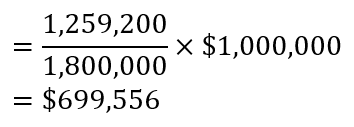
Anyway, the gain attributable to seller / lessee will be as follows:


Step 4 - Remove the Gain Attributable to Seller / Lessee from Total Gain 

Dr Gain on disposal $559,644
Cr Right-of-use asset $559,644

Summary

In summary, below represents the double entry for the sales and leaseback:

Dr Bank $2,000,000
Dr Right-of-use Asset (1,259,200-559,644) $699,556
Cr PPE $1,000,000
Cr Lease liability (200,000+1,259,200) $1,459,200
Cr Gain on disposal (800,000-559,644) $240,356

Alternatively, the right-of-use asset can also be calculated using the following method:

Right of use asset
= Ratio of portion attributable to seller or lessee x Previous carrying amount of the asset


Consistent with the logic of partial disposal, the right-of-use asset represents the portion of the previous carrying amount of the asset retained by the seller / lessee.

Scenario 2 - Sales Proceed Received is Lesser Than Fair Value
Company A sells a building to Company B for cash of $2 million. The fair value of the building is $2.2 million. The carrying amount of the building immediately before the sale is $1 million.  
At the same time, Company A enters into a contract with Company B for the right to use the building for 18 years, with annual payments of $120,000 payable at the end of each year. The interest rate implicit in the lease is 4.5%, which results in a present value of the annual payments of $1,459,200.   
The sale of the building to Company B meets the definition of a sale under IFRS 15.
As noted in the bold sentence above, the sales proceed of $2 million is lower than the fair value of the building of $2.2 million. The difference of $0.2 million will be treated as prepayment of lease payment.

In other words, the sales proceed of $2 million can also be broken down into the following:

1. Company A receives the proceed of $2.2 million when sell the building.
2. Then Company A will pay $0.2 million to the seller / lessor as prepayment.

$2.2 million received minus $0.2 million paid, hence we get $2 million net proceed.

Let's follow through the four (4) steps required for seller / lessee.

Step 1 - Derecognise the Asset

The double entry for derecognition will be as follows:

Dr Bank $2 million
Dr Lease prepayment $0.2 million
Cr PPE $1 million
Cr Gain on disposal $1.2 million

As shown above, the gain on disposal of $1.2 million is calculated as the difference between the fair value of the asset ($2.2 million) and the carrying amount of the asset ($1 million). The difference of $0.2 million is recognised separately as a lease prepayment.

Step 2 - Recognise the Leaseback

Dr Right-of-use Asset $1,659,200
Cr Lease liability $1,459,200
Cr Lease prepayment $200,000

In step 2, when we recognise right-of-use asset, the prepayment of $200,000 will be reclassified to right-of-use asset. According to paragraph 24(b) of IFRS 16, it is mentioned that the cost of the right-of-use asset shall comprise any lease payments made at or before the commencement date (i.e. prepayment).

The lease liability will be recognised at $1,459,200 and right-of-use asset will be the total of $1,459,200 and $200,000.

Step 3 - Calculate the Gain Attributable to Seller / Lessee (Gains Related to Portion Not Transferred to Buyer / Lessor)


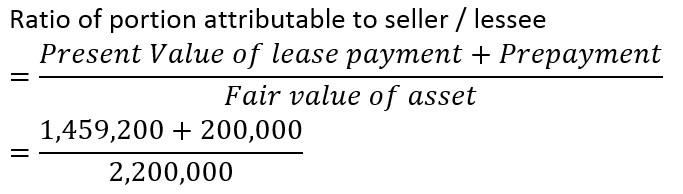
Take note that as we have prepayment of $200,000, we need to include it into the ratio calculation (as shown above). We are comparing $1,659,200 (the lease payment together with prepayment) with the fair value of $2,200,000 (also includes prepayment) so as to achieve apple with apple comparison.

Oops, I am sorry orange, even though both of you are fruits, an apple must still be compared with an apple, so I must politely say, "Please get out!" 😂😂😂

Anyway, the gain attributable to seller / lessee will be as follows:


Step 4 - Remove the Gain Attributable to Seller / Lessee from Total Gain 

Dr Gain on disposal $905,018
Cr Right-of-use asset $905,018

Summary

In summary, below represents the double entry for the sales and leaseback:

Dr Bank $2,000,000
Dr Right-of-use Asset (1,659,200-905,018) $754,182
Cr PPE $1,000,000
Cr Lease liability $1,459,200
Cr Gain on disposal (1,200,000-905,018) $294,982

Alternatively, the right-of-use asset can also be calculated using the following method:

Right of use asset
= Ratio of portion attributable to seller or lessee x Previous carrying amount of the asset

Consistent with the logic of partial disposal, the right-of-use asset represents the portion of the previous carrying amount of the asset retained by the seller / lessee.

Accounting for Buyer / Lessor (Relevant for SBR)

The accounting for buyer / lessor is the same as what I have explained previously in Part 1. You can refer to the explanation there.

Conclusion

Sales and leaseback can be complicated, but if we dissect the steps slowly and follow through the four steps that I have mentioned, I believe you will be able to understand them. As long as you understand the logic behind partial disposal, then you will be able to understand sales and leaseback. Wish you all the best in your studies and everything you do!


Tuesday, 27 August 2019

IFRS 16 - Sales and Leaseback (Part 1)

Sales and leaseback under IFRS 16 Leases can be quite confusing to many students. As such, I hope to make it simpler for you.

Note: This post is suitable for ACCA students who are studying for Financial Reporting (FR) or Strategic Business Reporting (SBR). However, SBR students will need to know the accounting treatments for both lessor and lessee whereas FR students will only need to know the accounting treatments for lessee.

Let's start with clarifying the difference between lessor and lessee:

Lessor - the person who rents out an asset to lessee. Lessor will collect rental income from lessee.

Lessee - the person who uses the rented asset of lessor. Lessee will pay rental income to lessor for the right of use of the leased asset.

Therefore, in a normal leasing scenario, this is what happens:


For sales and leaseback, there are essentially two transactions:

1. Company A (seller) sells the asset to Company B (buyer). Company B will pay Company A for the purchase of asset.


2. Company A will then lease the same asset back from Company B (leaseback). As such, Company A (the seller) is now the lessee whereas Company B (the buyer) is now the lessor. Being a lessee, Company A will pay rental to Company B.


Before we proceed, make sure you understand and remember this:

Seller = Lessee 
Buyer = Lessor

The reason why an entity decides to engage in such transactions is because it is a way to obtain funding. When Company A sell off their asset, Company A will get a lump sum amount from Company B. Thereafter, they just need to pay rental to Company B. As such, from Company A's perspective, Company A will be able to have a better cash flows because they receive one lump sum amount upfront and the future cash outflows are just rental payments.


So now the first important question to be asked is this:
For the first transaction (i.e. the sales from Company A to Company B), is it really a sale or is it just a way for Company A to obtain a loan (i.e. the asset "sold" is just a collateral for the loan)?
I mean obtain a loan, not forever alone!
The reason why this is important is that when we prepare financial statements, we need to reflect substance over form. Our financial statements should "represent faithfully the substance of the phenomena it purports to represent" (conveniently copied and pasted from the 2018 IFRS Conceptual Framework).


I don't know if this is true but thank you for inventing copy and paste!!!😂😂😂

Anyway back to substance over form. The idea is that if it is a sale, then we reflect it as sales in financial statements. If it is not a sale, then it is a loan, so we need to reflect the loan in financial statements.

The next important question that we need to ask is:
How do we determine whether a transaction is a sale?
To answer this question, let's look at what paragraph 99 of IFRS 16 says:
An entity shall apply the requirements for determining when a performance obligation is satisfied in IFRS 15 to determine whether the transfer of an asset is accounted for as a sale of that asset.
Let's look at what IFRS 15 has to say about satisfying a performance obligation (paragraph 31 of IFRS 15):
An entity shall recognise revenue when (or as) the entity satisfies a performance obligation by transferring a promised good or service (i.e. an asset) to a customer. An asset is transferred when (or as) the customer obtains control of that asset.
As such, we can now conclude that a transaction is a sale if Company B obtains control of the asset sold by Company A. If Company B does not obtains control of the asset, then Company B is actually providing a loan to Company A.

Let's elaborate the accounting treatments below:

When The Transaction Is NOT a Sale

So if the first transaction is not a sale, it means that Company A still control the asset and Company B do not have any control of the asset. In substance, Company A is borrowing money from Company B and Company A is providing the asset as collateral (security) for the loan. This is represented in the diagram below:


As there is no sale of asset by Company A, Company A will not derecognise their asset. Instead, Company A will recognise a financial liability (i.e. a loan or liability) under IFRS 9 when they receive the fund.

Dr Bank XX
Cr Financial Liability (Loan Payable) XX

Company B will recognise a financial asset when they provide loan to Company A:

Dr Financial Asset (Loan Receivable) XX
Cr Bank XX

The subsequent "rental" payment made by Company A to Company B is not a rental payment, but it is actually repayment of the loan, as shown below:


So from Company A's point of view, the double entry for such repayment of loan will be something like this:

Dr Financial Liability (Loan Payable) XX
Dr Finance Cost (interest expense in Profit or Loss) XX
Cr Bank XX

For Company B, the double entry when they receive the repayment of the loan will be something like this:

Dr Bank XX
Cr Financial Asset (Loan Receivable) XX
Cr Finance Income (interest income in Profit or Loss) XX

The financial liability of Company A and the financial asset of Company B will be dealt with under IFRS 9 and generally both of them will be accounted for using amortised cost if the criteria under IFRS 9 are fulfilled. 

Note that we will not cover the accounting treatment of IFRS 9 in this post.

When The Transaction IS a Sale

So if the first transaction is a sale, it means that Company A does not control the asset anymore because the control has been transferred to Company B. As such, Company A (seller) should record the sale of asset (i.e. the asset is derecognised and a gain/loss on disposal should be recognised).

However, this is not as straightforward as a normal disposal of asset. This is because in a normal disposal of asset, the seller will transfer 100% of the asset to the buyer. After the sale, the seller will no longer use the asset. In this case, the seller recognises the full (100%) gain or loss on disposal.

But for sales and leaseback, the seller will subsequently leaseback the asset and continue to use the asset. As such, the disposal is not 100% because the seller still has the right to use the asset after the disposal. 

In other words, the seller still retains some of the portion of the asset originally owned (because the seller is still using it after the sales).

As such, in order to faithfully represent the sales and leaseback, because the disposal is not 100%, the seller can only treat the disposal as partial disposal. This means that seller DOES NOT recognise 100% of the gain or loss on disposal. Seller only recognises part of the gain, i.e. recognises the gain or loss for the portion that is transferred to the buyer or lessor.

To make the above points clearer:

1. The gain or loss TO BE recognised in Profit or Loss by the seller is only the portion of the gain or loss that is transferred to the buyer (lessor). In short, we call this portion as gain or loss attributable to the buyer / lessor. 

2. The portion of the gain or loss that is not transferred to the buyer (lessor) is NOT recognised by the seller. In short, we call this portion gain or loss attributable to the seller / lessee (Note: attributable to seller / lessee as it represents the portion not transferred to buyer. Not transferred means still belong to seller, hence attributable to seller).

This can be represented using the diagram below:


Let's use an example to illustrate the above:
Company A sells a building to Company B for cash of $2 million. The fair value of the building is equal to the cash consideration of $2 million. The carrying amount of the building immediately before the sale is $1 million. 
At the same time, Company A enters into a contract with Company B for the right to use the building for 18 years, with annual payments of $120,000 payable at the end of each year. The interest rate implicit in the lease is 4.5%, which results in a present value of the annual payments of $1,459,200. 
The sale of the building to Company B meets the definition of a sale under IFRS 15.
Company A sells building to Company B at $2 million

Company A leases back the building and pay annual rental of $120,000 to Company B.
Solutions

As the transactions is a sale, we shall account for it as a sale. 

Seller / Lessee Accounting

In general, there are four (4) steps to be followed for a sale and leaseback scenario if we are performing the accounting for seller / lessee.

Step 1 - Derecognise the Asset

The first step is to account for the sale of the building. In other words, the building will be derecognised and a gain or loss is recognised. 

Note: For Step 1, we will treat the derecognition as if it is a full disposal (i.e. to treat the derecognition normally) for now. We will adjust for partial disposal later on in Step 3 and 4.

Dr Bank $2m
Cr PPE $1m
Cr Gain on disposal $1m

As shown in the double entry above, the gain on disposal is $1 million. However, this represents the total gain of disposal. As we can only recognise the gain attributable to the buyer / lessor, we will need to remove the gain attributable to seller / lessee from the total gain (this will be shown in Step 3 and 4 later).

Step 2 - Recognise the Leaseback

The second step is to recognise the leaseback of the building from Company B. According to IFRS 16, the lessee shall recognise a right-of-use asset and a lease liability based on the present value of the lease payment ($1,459,200).

Dr Right-of-use asset $1,459,200
Cr Lease liability $1,459,200

Step 3 - Calculate the Gain Attributable to Seller / Lessee (Portion of Gain Not Transferred to Buyer / Lessor)

Now we will need to calculate the gain which is attributable to Company A (the seller / lessee). In other words, we are now calculating the portion of the gain not transferred to the buyer / lessor. Remember that portion of gain not transferred to buyer / lessor cannot be recognised in Profit or Loss. As we have recognised 100% gain in Step 1, we shall remove the gain calculated in this step from the total gain at a later stage in step 4.

Based on the question, the present value of lease payment is $1,459,200. This represents the present value of the lease payment that Company A is required to pay in the future. In other words, this value belongs to Company A (seller / lessee).

As such, we can come out with a ratio as follows:


In other words, Company A will pay a present value of $1,459,200 for the asset and this is 72.96% of the total fair value of asset. We can therefore say that Company A is using 72.96% of the asset. 

As such, we cannot recognise 72.96% of the gain because 72.96% of the gain is attributable to Company A - the seller / lessee. We can only recognise the remaining 27.04% of the gain (i.e. gain that is attributable to the buyer / lessor - Company B).

We shall use this ratio to multiply with the total gain on disposal of $1 million in order to find the gain attributable to seller / lessee:


After this calculation, we can move into Step 4.

Step 4 - Remove the Gain Calculated in Step 3 from Total Gain Calculated in Step 1

In this step, we remove the gain by debiting gain on disposal. The corresponding adjustment is made to the right-of-use asset.

Dr Gain on disposal $729,600
Cr Right-of-use asset $729,600

In order words, from the total gain of $1 million, we have removed the gain attributable to seller / lessee of $729,600. What is left behind is the gain attributable to buyer / lessor, which is $270,400, as shown below:


That's all for the adjustment for sales and leaseback.

Summary

Below represents the summary of all the double entries from Step 1 to Step 4

Dr Bank $2,000,000
Dr Right-of-use Asset (1,459,200-729,600) $729,600
Cr PPE $1,000,000
Cr Lease Liability $1,459,200
Cr Gain on disposal (1,000,000-729,600) $270,400*

* Gain attributable to buyer / lessor

Subsequently, the requirement of lessee under IFRS 16 will be applied.

Note: The value of the right-of-use asset as shown above ($729,600) can also be calculated using the following method:

Right of use asset
= Ratio of portion attributable to seller or lessee x Previous carrying amount of the asset

Applying the same logic of partial disposal, the right-of-use asset represents the portion of the previous carrying amount of the asset retained by the seller / lessee (i.e. 72.96% of $1,000,000).

Buyer / Lessor Accounting (Relevant for SBR only)

As Company B (buyer / lessor) obtains control of the building, Company B will recognise the asset.

Dr Investment Property $2 million
Cr Bank $2 million

As Company B obtains a property which will be rented out to Company A, Company B has obtained an investment property under IAS 40.

Note: If the leased asset is a plant and machinery, then the buyer / lessor would have acquired property, plant and equipment (PPE) under IAS 16.

The subsequent lease to Company A would depend on whether it is a finance lease or operating lease. The requirement of lessor under IFRS 16 will be applied from this point onwards (which will not be covered in details in this post).

Generally, if the lease to Company A qualifies as finance lease, then the investment property will be derecognised and a financial asset will be recognised (this financial asset is also known as net investment in lease). Finance income will be recognised and any payment received from Company A will reduce the net investment in lease.

If the lease to Company A qualifies as operating lease, then the investment property will not be derecognised. Instead, Company B will recognise the rental income received from Company A on a straight line basis. Generally, the investment property will be measured using fair value model under IAS 40, with the changes in fair value reflected in the Profit or Loss. If the leased asset is PPE, then it will be held under cost model or revaluation model under IAS 16.

Hope that you will find the above illustrations useful!

I will write about the case for sales and leaseback in which the selling price is not equal to the fair value of the asset transferred in Part 2. Stay tuned!