Showing posts with label SBR. Show all posts

Monday, 9 March 2020

Impact of MFRS 16 on AirAsia Group Bhd

Disclaimer: The content in this blog post contains my own opinion and it should not be relied upon for making any decisions.

Recently, while I was browsing Facebook, I saw this news by The Borneo Post Online in Facebook:

AirAsia Group Bhd slipped into the red with a net loss of RM303.72 million for the financial year ended Dec 31, 2019 (FY19) compared with a net profit of RM1.97 billion in the preceding year.
Posted by Borneo Post Online on Thursday, February 27, 2020


According to the news, the reasons for AirAsia Group Bhd to suffer net loss in the financial year 2019 were partly due to the following:
"The weaker bottom-line, despite a 17 per cent jump in revenue to RM12.45 billion, was partly attributed to accounting treatment of the restructured aircraft ownership, moving from owning to leasing aircraft, despite recording similar cash outflow in either financing method, the low-cost airline said."
"According to the company, the adoption of Malaysian Financial Reporting Standard (MFRS) 16 reduced its net operating profit by RM130.9 million while the MFRS 137 accounting treatment led to a 43 per cent jump in maintenance and overhaul costs."
"The airline’s bottom-line was partly weighed down by a depreciation of right-of-use assets of RM1.76 billion and finance costs (lease liabilities) of RM505.87 million following the adoption of MFRS 16."
I thought it will be interesting to analyse the accounting treatments in this news as it will be relevant to ACCA students (especially SBR students as it will be good for you to apply what you learnt in the class to the actual business world). Hence, I write this post which contains my opinion on the impact of the above accounting treatments.

IFRS 16 Treatment


According to IFRS 16 Leases, when an entity leases an asset, the entity is required to recognise a right-of-use asset and a lease liability.

Generally, the right-of-use asset will be depreciated whereas finance cost will be recognised on lease liability.

This is in contrast with the previous IAS 17 Leases where an entity may have finance lease and operating lease. The accounting treatment of finance lease is similar to the current IFRS 16 treatment (hence there isn't much impact for finance lease under IFRS 16). However, for operating lease, the treatment was to expense off the lease payment in Statement of Profit or Loss (SOPL).

Refer to the table below for a comparison between IAS 17's operating lease and IFRS 16's treatment:


IAS 17 Operating Lease
IFRS 16
Expenses 
Lease payment 
(rental paid)
Depreciation of right-of-use asset
Finance cost on lease liability
Asset
None
Right-of-use asset
Liability
None
Lease liability

As we can see from the above, under IFRS 16, the entity may have potentially more expenses as well as having a higher asset and liability figure.

Let's have a look at AirAsia's recent fourth quarter report ended 31 December 2019 (the relevant results are summarised in the table below):


Cumulative

Year Ended
31/12/2019
RM’000
Year Ended
31/12/2018
RM’000
Aircraft operating lease expenses
-
(1,155,680)
Depreciation of right of use asset
(1,762,663)
-
Finance costs - lease liabilities
(505,873)
-

Total expenses related to IFRS 16 / IAS 17
(2,268,536)
(1,155,680)

As we can see from the above, there have been around 96% increase in the expenses once IFRS 16 is adopted.


Whereas for the increase in right-of-use asset and lease liability:


As At
31/12/2019
RM’000
As At
31/12/2018
RM’000
Right of use assets
12,219,457
-


Lease liabilities – current liabilities
2,104,702
-
Lease liabilities – non-current liabilities
10,156,869


A full 100% increase. 

However, it should be noted that AirAsia Group Bhd did not apply full retrospective adjustment under IAS 8. It was mentioned in the notes to the unaudited financial statements that:
"On the date of initial application (of MFRS 16), the Group applied the simplified transition approach and did not restate comparative amounts for the period prior to first adoption."
In any case, with the increase in right-of-use assets (i.e. increase in capital employed), the return on capital employed (ROCE) of the company will definitely be impacted (i.e. reduced).

Not only that, the lease liabilities will also increase the gearing ratio of the company.

As such, we can now see that IFRS 16 might cause some impact on the financial statements which might be perceived as negative as investors (despite the fact that all these are just accounting adjustments).

Restructured Aircraft Ownership

Next, we shall explore the issue on the restructuring in the aircraft ownership of AirAsia Group Bhd. In the news, it was mentioned that the company was "moving from owning to leasing aircraft".

To understand this, it is necessary for us to understand what was happening to AirAsia Group Bhd in the year 2019. Let's look at one news on AirAsia in year 2019:

The company plans to fully shift to the new model by completely withdrawing from aircraft ownership.
Posted by The Star on Sunday, June 2, 2019


In short, AirAsia Group Bhd had decided to went into sales and leaseback agreements.

Image from IFRS Box.
Note: I have written the accounting treatment of sales and leaseback agreement previously. You can read more at the link below if you are interested to know more:

1. https://tysonspeaks.blogspot.com/2019/08/ifrs-16-sales-and-leaseback-part-1.html
2. https://tysonspeaks.blogspot.com/2019/08/ifrs-16-sales-and-leaseback-part-2.html

Borneo Post had mentioned that "MFRS 137 accounting treatment led to a 43 per cent jump in maintenance and overhaul costs". MFRS 137 is similar to IAS 37 Provisions, Contingent Liabilities and Contingent Assets.

If you look into AirAsia's recent fourth quarter report ended 31 December 2019, you will realise the following:


Cumulative

Year Ended
31/12/2019
RM’000
Year Ended
31/12/2018
RM’000
Maintenance and overhaul
(1,320,820)
(938,369)

An increase of around 41% in expense, which is similar to what was being reported in Borneo Post.

In relation to the provision balance we see that provision balance has also increased, as shown below:


As At
31/12/2019
RM’000
As at
31/12/2018
RM’000
Aircraft maintenance provisions / payables


-          Current liabilities
1,861,748
878,941
-          Non-current liabilities
3,547,776
4,049,068
Total
5,409,524
4,928,009

According to the notes to the unaudited financial statements, it is mentioned that:
"Aircraft maintenance provision/ payables relates to maintenance costs that needs to be incurred for maintaining the aircraft as long as it is currently still in use and on the return of lease aircraft."
It seems like the Borneo Post's news is implying that maintenance and overhaul expenses had increased because of the sales and leaseback transactions which happened during the year 2019 and the increase is due to requirement in MFRS 137 (or IAS 37).

Hence the question - why is it that when a company start to lease asset, they may need to recognise more expenses as well as more provision?

Well, here is my opinion on the possible reason (Note: this is only my own opinion and guess as I do not have the details of the sales and leaseback agreement).

Owning Aircraft


Look at the beautiful sky!
If an airline company owns aircraft, the aircraft is accounted for under IAS 16 Property, Plant and Equipment (PPE). In relation to the repair and maintenance cost of the aircraft, it is stated in IAS 16, paragraph 14 that:
"A condition of continuing to operate an item of property, plant and equipment (for example, an aircraft) may be performing regular major inspections for faults regardless of whether parts of the item are replaced. When each major inspection is performed, its cost is recognised in the carrying amount of the item of property, plant and equipment as a replacement if the recognition criteria are satisfied. Any remaining carrying amount of the cost of the previous inspection (as distinct from physical parts) is derecognised."
In short, major inspection (or overhaul) of aircraft is recognised as part of the PPE and the previous carrying amount of the inspection or overhaul will be derecognised.

Apart from that, under IAS 37, paragraph 14, it is mentioned that provision shall be recognised when:

(a) an entity has a present obligation (legal or constructive) as a result of a past event;
(b) it is probable that an outflow of resources embodying economic benefits will be required to settle the obligation; and
(c) a reliable estimate can be made of the amount of the obligation.

As such, if an airline company owns aircraft, they may not be able to recognise provision on future maintenance or overhaul due to the reason that they may not be having present obligation as a result of past event to conduct the repair (unless they can demonstrate otherwise).

Instead, a major overhaul will be capitalised as PPE and minor repair will be expensed off as and when it occurs. Provision is generally not recognised for future repair or overhaul if the entity owns the aircraft.

Leasing Aircraft

If an aircraft is leased, there is a contract in place. The contract may stipulate that the airline has to conduct regular maintenance and overhaul on the leased aircraft. This means that the airline company will have a present obligation (i.e. legal obligation) under the lease contract to perform the regular maintenance and overhaul.

As such, if wear and tear occurs to the aircraft (i.e. past event has occurred), the entity is obliged to perform the maintenance and overhaul under the lease contract. Thus, provision needs to be recognised when the wear and tear occurs.

Note: It is important to know that a provision can only be created if it results from a past event. If there is no wear and tear, provision cannot be recognised. In other words, provision can only be created if there is a "present obligation" (i.e. the lease contract which gives rise to legal obligation) and a "past event" has occurred (known as obligating event, i.e. the wear and tear event which makes the company to be obliged to pay for the repair cost).

Hence, if a company moves from owning aircraft to leasing aircraft, it is possible for more provision to be recognised. This could explain the reason for the increase in maintenance and overhaul cost of AirAsia Group Bhd.

Conclusion


As we can see from the above, new accounting standard (i.e. IFRS 16) can impact financial statements in several ways and it is important for us to understand these impacts so as to be able to explain these impacts to the users of financial statements.

We can also see that a change in the ways of conducting business will have some accounting impacts. For AirAsia Group Bhd, sales and leaseback of aircraft might be a good way to raise finance, but it may result in lower profitability due to increase in provision as well as increase in expenses related to IFRS 16.

Friday, 21 February 2020

IAS 36 - Is Liability Considered in The Measurement of Recoverable Amount?

Today we shall look into the case of whether liability is considered in the measurement of recoverable amount for impairment testing purpose.

Scenario

Let's look at the following example (this is extracted directly from the example in paragraph 78 of IAS 36):

"A company operates a mine in a country where legislation requires that the owner must restore the site on completion of its mining operations. The cost of restoration includes the replacement of the overburden, which must be removed before mining operations commence. A provision for the costs to replace the overburden was recognised as soon as the overburden was removed. The amount provided was recognised as part of the cost of the mine and is being depreciated over the mine’s useful life. The carrying amount of the provision for restoration costs is CU500, which is equal to
the present value of the restoration costs.

The entity is testing the mine for impairment. The cash‑generating unit for the mine is the mine as a whole. The entity has received various offers to buy the mine at a price of around CU800. This price reflects the fact that the buyer will assume the obligation to restore the overburden. Disposal costs for the mine are negligible. The value in use of the mine is approximately CU1,200, excluding restoration costs. The carrying amount of the mine is CU1,000."

A picture of a mine.
Note: CU stands for currency units. It is just a term to replace currency such as $ or RM.

To summarise,

Carrying amount (CA) of the mine = CU1,000
CA of the provision for restoration costs = CU500
Fair value less cost of disposal (FVLCOD) of the mine = CU800
Value in use (VIU) of the mine (excluding restoration costs) = CU1,200

To understand how to solve this issue, we will need to understand some rules in IAS 36. After you understand the rule, then you can come back to this case again.

Back to Basic

According to IAS 36, impairment happens when the CA exceeds recoverable amount (RA). RA is the higher of VIU and FVLCOD.

Image from IFRS box.
VIU means present value of the future cash flows expected to be derived from an asset or cash‑generating unit.

FVLCOD means the price that would be received to sell an asset in an orderly transaction between market participants (refer to IFRS 13) minus the incremental costs directly attributable to the disposal of an asset or cash-generating unit.

Cash-generating unit (CGU) is the smallest identifiable group of assets that generates cash inflows that are largely independent of the cash inflows from other assets or groups of assets.

Rules in Measuring Fair Value Less Costs of Disposal

IAS 36 also mentions that when we measure the cost of disposal in FVLCOD, we should not include in costs that have been recognised as liabilities. Refer to below (paragraph 28 of IAS 36):
"Costs of disposal, other than those that have been recognised as liabilities, are deducted in measuring fair value less costs of disposal."
For example, if we have already recognised a provision for dismantling or restoration cost, we need not minus such dismantling or restoration cost when we calculate FVLCOD. The reason is to prevent double counting as the liability has already been recognised in the financial statements.

Rules in Measuring Value In Use

IAS 36 also mentions that in the measurement of VIU, we do not include the cash outflows relating to obligations that have been recognised as liabilities. Refer to below (paragraph 43(b) of IAS 36):
"To avoid double‑counting, estimates of future cash flows do not include cash outflows that relate to obligations that have been recognised as liabilities (for example, payables, pensions or provisions)."
This is basically the same rule for measuring FVLCOD. If we have already recognised a provision for dismantling or restoration cost, we need not minus such dismantling or restoration cost when we calculate VIU.

Reasons for The Rules of Not Minus Costs That Have Been Recognised as Liabilities

We can see that for both the rules in measuring FVLCOD and VIU, we do not minus costs or cash outflows that have been recognised as liabilities.

To understand the logic behind this rule, we need to understand what does it mean by "cost / cash outflows that have been recognised as liabilities".

A good example would be provision for dismantling cost. Such provision is recognised as liability in the financial statements. It will also be capitalised as part of the asset (e.g. PPE). Subsequently, the asset value (together with the capitalised dismantling cost) will be depreciated and it will be charged to SOPL.

In other words, we can say that the provision for dismantling cost will ultimately be charged to SOPL as expense. This makes profit figure to be lower.

For impairment loss, generally we charge impairment loss to SOPL. This also reduces profit.

Consider the following:

If we minus the cost of dismantling when we calculate FVLCOD and VIU, it will cause the FVLCOD and VIU to be lower. This will increase impairment loss and profit will be reduced (e.g. if CA is 100 and VIU is 80, impairment is 20. However, if VIU is lowered to 60, impairment will be increased to 40 and profit will be reduced).

Therefore, if we have already recognised provision for dismantling cost, our profit would have been reduced by the dismantling cost. If we minus cost of dismantling again in FVLCOD and VIU, this makes impairment loss amount to be larger, and hence profit will be reduced by the cost of dismantling again.

In other words, we would have double counted the impact on dismantling in our profit (i.e. it is charged to SOPL twice). Hence, to prevent such double counting, the rule is that we are not to minus such cost or cash outflows in FVLCOD and VIU.

Exception to the Above Rules


There is an exception to the rules mentioned above. This happen if a buyer wishes to buy over the asset together with the associated liability. Consider the following case:

Let say we have an asset with fair value of $1,000 and a buyer want to buy this asset from us. However, this asset comes with a liability to dismantle it at the end of the useful life. Let's say this liability is having the present value of $200.

(Note: We have also recognised a provision for dismantling cost in our financial statements.)

Logically, the buyer will not offer us $1,000 to buy the asset from us. The buyer may offer $800 only because the buyer will need to pay for the future dismantling cost.

(Note: when deciding the offer price, the buyer will deduct dismantling cost and give us the net offer price of $800.)

FVLCOD is thus $800. However, this figure is derived after the buyer deducts dismantling cost. Notice that this FVLCOD of $800 is not consistent with the measurement rule as explained above.


According to the rule as mentioned above, we are not supposed to minus dismantling cost from FVLCOD if we have already recognised a provision.

IAS 36 acknowledges this issue, and this was mentioned in paragraph 78:
"It may be necessary to consider some recognised liabilities to determine the recoverable amount of a cash‑generating unit. This may occur if the disposal of a cash‑generating unit would require the buyer to assume the liability. In this case, the fair value less costs of disposal (or the estimated cash flow from ultimate disposal) of the cash‑generating unit is the price to sell the assets of the cash‑generating unit and the liability together, less the costs of disposal. To perform a meaningful comparison between the carrying amount of the cash‑generating unit and its recoverable amount, the carrying amount of the liability is deducted in determining both the cash‑generating unit’s value in use and its carrying amount."
In short, because the FVLCOD of $800 is derived after minus the dismantling cost, therefore when we perform impairment testing, we should also minus dismantling cost when we calculate the carrying amount as well as the value in use.

Application to the Scenario

After you understand the exception to the rule, you can now go back and read the case at the beginning of this post again.

As a recap:

CA of the mine = CU1,000
CA of the provision for restoration costs = CU500
FVLCOD of the mine = CU800
VIU of the mine (excluding restoration costs) = CU1,200

In this case, the FVLCOD of CU800 is a net offer price by the buyer (meaning the buyer has already deducted the restoration cost in arriving at CU800).

As such, to achieve apple with apple comparison, we need to minus the provision for restoration cost when we calculate carrying amount and VIU:

CA = CU1,000 - CU500 = CU500

VIU = CU1,200 - CU500 = CU700
FVLCOD = CU800 (Note: buyer already minus dismantling cost)

RA = CU800 (higher of VIU and FVLCOD)

In this case, there is no impairment because the CA is less than RA.

Refer to the following for the explanation by IAS 36:
"The cash‑generating unit’s fair value less costs of disposal is CU800. This amount considers restoration costs that have already been provided for. As a consequence, the value in use for the cash‑generating unit is determined after consideration of the restoration costs and is estimated to be CU700 (CU1,200 less CU500). The carrying amount of the cash‑generating unit is CU500, which is the carrying amount of the mine (CU1,000) less the carrying amount of the provision for restoration costs (CU500). Therefore, the recoverable amount of the cash‑generating unit exceeds its carrying amount."
Conclusion

In conclusion, whenever we make comparison, it is important to compare apple with apple. The illustration above demonstrate the importance of comparing apple with apple. 

Sunday, 22 September 2019

IAS 12 - How To Determine Tax Base (Part 3)

This is the third part of how to determine tax base. For the previous posts, you can refer to the following link:

Part 1 - https://tysonspeaks.blogspot.com/2019/08/ias-12-how-to-determine-tax-base-part-1.html

Part 2 - https://tysonspeaks.blogspot.com/2019/09/ias-12-how-to-determine-tax-base-part-2.html

For Part 3, I am going to discuss about how to determine the tax base for liability as well as tax base for some specific scenarios involving the accounting standards in the Financial Reporting (FR) paper of ACCA.

Tax Base of Liability


Before we go into the details, let's look again at the definition of tax base of liability according to IAS 12:
The tax base of a liability is its carrying amount, less any amount that will be deductible for tax purposes in respect of that liability in future periods. In the case of revenue which is received in advance, the tax base of the resulting liability is its carrying amount, less any amount of the revenue that will not be taxable in future periods.
In general, there are two points:

(a) Generally, the tax base of the liability will be equal to its carrying amount unless the liability represents an expense which will only be deductible in the future when it is paid. In this case, the tax base is the carrying amount minus the amount that will be deductible in the future (e.g accrued expenses in which deduction is given in the future when the liability is paid - deduction on cash basis).

(b) If the liability represents an income received in advance, then the tax base is the carrying amount minus any revenue that is not taxable in the future (e.g. an income received in advance which is taxed in this year on receipt basis. This income will not be taxable in the future).

You will understand more after going through the following illustrations:

1. Trade Payables


The entity incurs an expense of $100 on credit. The accounting double entry is:

Dr Expenses (SOPL) $100
Cr Trade payables $100

In this case, the carrying amount of the liability is $100.

Tax treatment: Assuming that the tax rule provides that such expense is deductible on an accrual basis (i.e. deduction is given even though the entity has not paid for the expense).

The imaginary tax double entry in the imaginary tax financial statements will be:

Dr Deductible expenses $100
Cr Trade payables $100

As we can see from the above, the tax base of the liability is also $100 because $100 is deductible in this year.

Since the CA and TB are the same, there will be no deferred tax because the accounting rule and tax rule are the same.

Note: Referring back to the definition, as none of the $100 liability is deductible in the future (the full $100 has already been deducted in the current year), the tax base is equal to its carrying amount of $100.

2. Accrued Expenses Which Is Deducted on Cash Basis


An entity has accrued water and electricity expenses of $100 for the month of December. Such expense has not been paid by year end. The accounting double entry is:

Dr Expenses (SOPL) $100
Cr Accrued expenses $100

In this case, the carrying amount of the liability is $100.

Tax treatment: Assuming that tax rule provides that the deduction for such expenses can only be made when the entity has paid for the expenses.

As the entity has not paid for the expenses, there will be no tax double entry. Accordingly, it follows that there is no tax base because the expense is not deductible in this year.

As such, CA = $100 and TB = $0. As CA > TB and this is a liability, this represents a DTD of $100.

Reason for DTD: The entity will pay higher tax this year because deduction is not given this year. However, the entity will pay lesser tax in the future when deduction is given (hence DTD).

Note: Referring back to the definition, as the $100 liability will only be deducted in the future, the tax base is equal to its carrying amount ($100) less the amount that will be deductible in the future ($100). This will result in tax base to be equal to zero ($100 - $100).

3. Deferred Income Which Is Taxed on Cash / Receipt Basis


An entity receives $100 advance payment for services to be rendered in the future. As the performance obligation has not been satisfied, according to IFRS 15 Revenue from Contracts with Customers, revenue cannot be recognised. Instead, a deferred revenue (liability) should be recognised as follows:

Dr Bank $100
Cr Deferred revenue (liability) $100

In this case, the carrying amount of the liability is $100.

Tax treatment: Assuming that the tax rule mentions that the income will be taxed if the entity has received the income.

As the income is subject to tax in this year (since the entity has received the income), the imaginary tax double entry in the imaginary tax financial statements will be as follows:

Dr Bank $100
Cr Taxable income $100

In other words, in the tax SOFP, there will be no liability because the income has already been taxed this year. As such, tax base is equal to zero.

As CA = $100 and TB = 0 and this is a liability, there will be a DTD of $100 since CA > TB.

Reason for DTD: The entity will pay more tax in this year because the deferred income is subject to tax in this year. However, the entity need not pay tax again in the future (hence the future tax is lesser and it is DTD).

Note: Referring back to the definition, as the $100 income received in advance has already been taxed in this year, there will be no tax to be paid in the future. As such the tax base is the carrying amount ($100) less the revenue that will not be taxable in the future ($100). This will result in the tax base to be equal to $0 ($100 - $100).

4. Deferred Income Which Is Taxed in the Future

Assuming that the scenario is the same as scenario no.3 above, except that the tax treatment is that the income will not be taxed now, but it will only be taxed in the future when services are rendered.

In this case, the imaginary tax double entry in the imaginary tax financial statements will be similar to the accounting double entry:

Dr Bank $100
Cr Deferred revenue (liability) $100

As such, tax base of the liability is equal to $100 because we have not paid the tax.

As CA = $100 and TB = $100, it follows that there is no deferred tax. This is because the accounting rule and tax rule are the same.

Note: Referring back to the definition, as the $100 income received in advance will be taxed in the future, the tax base is the carrying amount ($100) less the revenue that will not be taxable in the future ($0). This will result in the tax base to be equal to $100 ($100 - $0).

5. Loan Payable


An entity borrowed $100 from the bank. The accounting double entry is as follows:

Dr Bank $100
Cr Loan payable $100

As such, the carrying amount of the liability is $100.

Tax treatment: When the entity receives the borrowing from the bank, there is no tax implication. When the entity makes repayment of loan to the bank, there is also no tax implication.

The imaginary tax double entry in the imaginary tax financial statements will be similar to the accounting double entry:

Dr Bank $100
Cr Loan payable $100

As the CA and TB are the same, it follows that there is no deferred tax. This is because the accounting rule and tax rule are the same.

Note: Referring back to the definition, as the $100 liability will not be deductible in the future, the tax base is equal to its carrying amount ($100) less the amount that will be deductible in the future ($0). This will result in tax base to be equal to $100 ($100 - $0).

6. Accrued Fines and Penalties


An entity accrues fines and penalties amounting to $100. The accounting double entry is as follows:

Dr Expenses (SOPL) $100
Cr Accrued fines and penalties $100

As such, the carrying amount of the liability is $100.

Tax treatment: Assuming that fines and penalties are not deductible for tax purposes.

The imaginary tax double entry in the imaginary tax financial statements will be similar to the accounting double entry:

Dr Non-deductible expenses $100
Cr Accrued fines and penalties $100

As such, the tax base of the liability is also $100.

As the CA and TB are the same, it follows that there is no deferred tax.

Note: Referring back to the definition, as the $100 liability will not be deductible in the future, the tax base is equal to its carrying amount ($100) less the amount that will be deductible in the future ($0). This will result in tax base to be equal to $100 ($100 - $0).

Alternatively, you can also argue that as fines and penalties are not deductible, the difference represents a permanent difference and deferred tax should be ignored. Both analysis will result in no deferred tax calculation.

There you go! This is the idea of how do we determine tax base for liability.

Next, I am going to cover about some specific scenarios involving the accounting standards in the Financial Reporting (FR) paper of ACCA.

Specific Scenarios

In this part, I will cover some scenarios involving the following:

1. Unutilised tax losses or unutilised tax credits
2. Leasing (IFRS 16)
3. Convertible loan note (IAS 32)

1. Unutilised Tax Losses / Unutilised Tax Credits


Unutilised tax losses (in Malaysia, this is known as unabsorbed business losses) refer to the tax losses that can be carried forward to the future so that it can be used to offset against taxable income that an entity will earn in the future. In other words, future tax can be reduced by these unutilised tax losses.

As the entity will pay lesser tax in the future, unutilised tax losses will result in deferred tax asset (DTA).

For example, if an entity is having unutilised tax losses of $100,000 and the tax rate is 25%, there will DTA of $25,000 ($100,000 x 25%).

However, do take note that paragraph 34 of IAS 12 mentions that such deferred tax asset can be recognised "to the extent that it is probable that future taxable profit will be available against which the unused tax losses and unused tax credits can be utilised."

In other words, using the same example as above, if the entity only expects that it can earn $70,000 taxable profit in the future, the entity can only recognise DTA of $21,000 ($50,000 x 25%) instead of the full $25,000 DTA.

The remaining DTA of $4,000 ($25,000 - $21,000) will not be recognised because the entity is not able to earn the extra $30,000. In other words, the entity will not be able to use the tax losses of $30,000 because the entity cannot earn the extra $30,000. As such, the DTA of $4,000 will only be disclosed in the notes to the financial statements.

2. Leasing


Under IFRS 16, a lessee (an entity who lease an asset) will recognise right-of-use asset as well as lease liability (the detailed accounting treatment under IFRS 16 is not covered in this post). Let's just say:

Right-of-use asset - $100
Lease liability - $90
Net CA of lease (asset) - $10

Tax treatment: Assuming that the tax rule provides that lease rental is treated as a deductible expense.

The imaginary tax double entry for the lease rental in the imaginary tax financial statements will be as follows:

Dr Deductible expenses $100
Cr Bank $100

As such, under the tax rule, there will be no asset because we just claim a deductible expense on lease rental. Tax base will be equal to zero.

As CA = 10 and TB = $0 and this is an asset, the difference of $10 represents TTD.

Reason for TTD: If there is a positive net asset of lease in the accounting SOFP, it means that there will be higher profit in the accounting SOPL (due to double entry). In other words, accounting profit is more than taxable profit for this year. As we only claim lease rental as deductible expenses for tax purpose, we will actually pay lesser income tax this year. In the future, our tax might be higher after we have claimed all the lease rental deduction (hence TTD).

Note: If the net CA of the lease is a liability, then the difference shall be DTD.

Reason for DTD: If there is a net liability of lease in the accounting SOFP, it means that there will be higher expenses (thus lower profit) in the accounting SOPL (due to double entry). In other words, accounting profit is lower than taxable profit for this year. We will pay more income tax in this year. In the future, our tax might be lower (hence DTD).

3. Convertible Loan Note (IAS 32)


Under IAS 32, convertible loan note needs to be split into loan component and equity component (the detailed accounting treatment under IAS 32 is not covered in this post). Let's just say we have a convertible loan note of $100 and upon initial recognition, the entity has determined that

Loan element - $90
Equity element - $10

The double entry upon initial recognition is

Dr Bank $100
Cr Convertible loan note $90
Cr Equity component $10

As such, the CA of the convertible loan note (liability) is $90.

Tax treatment: Assuming that we do not split the loan into loan and equity component as per tax rule.

As such, TB will be $100.

As CA = $90 and TB = $100 and this is a liability, the difference of $10 represents TTD.

Notes:

1. The deferred tax liability arising on initial recognition (as explained above) is not charged to SOPL. Instead, it is charged directly to the equity component. Remember, the deferred tax treatment should follow the accounting treatment. Since in accounting we credit equity component $10, we have to charge the deferred tax to the equity component too.

2. On subsequent accounting, when we apply amortised cost method to the carrying amount of convertible loan note, the carrying amount of convertible loan note will be increased by finance cost and reduced by actual interest paid. The subsequent changes in deferred tax liability as a result of this will be charged to SOPL because the finance cost on convertible loan note is charged to SOPL.


Congratulations! You have reached the end of this post!

In my next post on IAS 12, I will talk about some specific scenarios relevant for SBR students. So stay tuned!

Monday, 9 September 2019

IAS 12 - How To Determine Tax Base (Part 2)

This post is a continuation from Part 1. If you have not read Part 1, you can access it via the following link:

https://tysonspeaks.blogspot.com/2019/08/ias-12-how-to-determine-tax-base-part-1.html

In Part 1, we have covered the basic of deferred tax. In this post, we will cover the following:

1. Techniques that I use in determining tax base
2. Determining whether the temporary difference is taxable temporary difference (TTD) or deductible temporary difference (DTD).

For item no.1 above, the way that I use in determining tax base is by imagining the amount that would appear in the tax Statement of Financial Position (tax SOFP) if we prepare financial statements using tax rule.


To fully understand tax base, you will need to use some imagination. Normally, we adopt IAS/IFRS in preparing financial statements (we will call this accounting rule). However, let's just imagine, if we were to use income tax rule to prepare financial statements, the financial statements will become something like this:

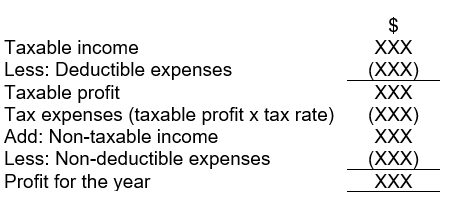
Tax Statement of Profit or Loss (Tax SOPL)


For tax purpose, we are concerned with taxable income and deductible expenses as these two items will determine taxable profit as well as the tax expenses. Thereafter, we also have the non-taxable income as well as non-deductible expenses in our tax SOPL. The final figure is the profit for the year.

Note: In practice we don't prepare SOPL using this manner. This is just my imagination.


Tax Statement of Financial Position (Tax SOFP)

If we prepare the SOPL using tax rule, the amount recognised in SOFP will also be different (due to different double entry).

The general idea is that tax base is the amount of asset or liability that is recognised in the tax SOFP if we prepare financial statements using tax rule.

Consider the definition of tax base in IAS 12 below:
The tax base of an asset or liability is the amount attributed to that asset or liability for tax purposes.
We can thus interpret tax base as the amount that is recognised in tax SOFP.

In a tax SOFP, we also have asset, liability and equity. As we know the basic accounting equation is:
Asset - Liability = Equity
In any case, I came across the following in Facebook:

17 Equations that changed the World..
Posted by Electronic Engineering on Thursday, August 1, 2019


I was wondering why accounting equation is not included.

Allow me to add on the #18:
Accounting Equation: Asset - Liability = Equity
Luca Pacioli, 1494 😂😂😂

Luca Pacioli, a.k.a. Thanos 😂😂😂

Anyway back to deferred tax. About the accounting equation, the idea when we calculate deferred tax is that we are going to compare all the assets and liabilities in both our accounting SOFP as well as tax SOFP (i.e. comparing carrying amount and tax base). We can ignore equity when we calculate deferred tax (since we already considered all the assets and liabilities).

Note: For this post, I will refer to the financial statements prepared using tax rule as "imaginary tax financial statements" because really, it is just my imagination ok 😂😂😂

You will understand more once you look into the different scenarios that I will illustrate below. But before we go into that, we will look into how do we determine whether a temporary difference is a taxable temporary difference or deductible temporary difference.

Taxable Temporary Difference (TTD) or Deductible Temporary Difference (DTD)?

In general, TTD means we are going to pay more tax in the future and DTD means we are going to pay lesser tax in the future. TTD will result in deferred tax liability whereas DTD will result in deferred tax asset. For the detailed explanation of what are these items, you can refer to Part 1.

There is a quick way to determine whether a temporary difference is TTD or DTD. You can use the following table in exam:

Note: CA represents carrying amount (value in accounting SOFP) whereas TB represents tax base (value in tax SOFP).

To illustrate:

1. For an asset, if the CA is larger than the TB, the difference is a TTD.
2. For an asset, if the CA is smaller than the TB, the difference is a DTD.
3. For a liability, if the CA is larger than the TB, the difference is a DTD.
4. For a liability, if the CA is smaller than the TB, the difference is a TTD.

All you need to do is to memorise the one that I highlighted in yellow (i.e. the first point above). For the rest, all you need to do is just to fill in the table by following the arrows as shown below:


Notice the arrow above? Yes, there is an animation. It is a gif. You can trust your eyes

When you fill in the table, all you need to do is to insert a reverse entry. In other words, for the column CA > TB, when you move down the arrow from TTD, you will fill in DTD. Then when you move to the right, you are going to fill in TTD. Then finally, when you move up, you will fill in DTD.

With this, we can now look into the different scenarios for deferred tax.

Tax Base of Assets


Before we go into the details, let's look at the definition of the tax base of an asset according to IAS 12:
The tax base of an asset is the amount that will be deductible for tax purposes against any taxable economic benefits that will flow to an entity when it recovers the carrying amount of the asset. If those economic benefits will not be taxable, the tax base of the asset is equal to its carrying amount.
In short, there are two main points:

(a) If an amount is deductible in the future (e.g. asset in which we can claim capital allowance), then that amount is the tax base for an asset.

(b) If we have an asset (e.g. receivable) in which we need not pay additional tax in the future when we receive the money, then tax base is equal to its carrying amount.

The various examples below would illustrate the two main points above.

1. Property, Plant and Equipment (PPE) which qualifies for capital allowance (tax depreciation)

This is the scenario that I have covered in Part 1. In this case, if we have a PPE in which we can claim capital allowance or tax depreciation, then we will have a tax base for that PPE.


Scenario: An entity purchased a machine for $100. The useful life is 5 years. For tax purpose, the entity can claim 50% tax depreciation. As such, for the first year,

CA = $100 - $100/5 = $80
TB = $100 - $100 x 50% = $50

If we were to apply tax rule in preparing financial statements, our tax SOFP will have an asset of $50 (after we charge 50% tax depreciation in our tax financial statements). As such, $50 is the tax base, indicating that we can claim $50 capital allowance in the future (an amount which is deductible in the future).

As we can see above, the CA is larger than TB. Referring to the table, as this is an asset, this represents a TTD which is equal to $30 ($80-$50).

Reason for TTD: The tax depreciation is faster than the accounting depreciation. In other words, the entity will pay lesser tax this year. In the future, the entity will have lesser or no tax depreciation if compared to accounting depreciation. This will result in higher tax payable in the future (hence TTD).

2. PPE which does not qualify for capital allowance (tax depreciation)

I have also covered this scenario in Part 1.


Scenario: An entity purchased a piece of land for $100 which does not qualify for capital allowance or tax depreciation.

If we were to prepare financial statements using tax rule, our imaginary tax double entry will be as follows (Note: this is not the real double entry. This is just my imagination of the double entry in the imaginary tax financial statements):

Dr Non-deductible expenses (Tax SOPL) $100
Cr Bank $100

In other words, since the land does not qualify for capital allowance, there is no asset in the tax SOFP. Therefore, the tax base of this land is zero because there is no amount of asset that will be deductible in the future.

As such, CA of the land is $100 and the TB is zero. This is the case when CA > TB. As this is an asset, the difference should be a TTD of $100 (but this is not true, read below).

In Part 1, I mentioned that no deferred tax is recognised for permanent difference. In this case, the difference is a permanent difference because the land will never be deductible for tax purposes (i.e. the accounting treatment will be forever different from the tax treatment). As such, we DO NOT calculate deferred tax for this scenario.

3. PPE under Revaluation Model (IAS 16)


Scenario: An entity purchased a piece of land for $100 which does not qualify for capital allowance or tax depreciation. The land is not depreciated for accounting purpose. However, the entity adopts revaluation model for land under IAS 16. As at year end, the fair value of the land has increased to $120.

Tax treatment: Assume that the land does not qualify for capital allowance. As such, the TB is zero. However, if the entity sell off the land in the future, the gain on disposal is taxable under capital gain tax (in Malaysia this is known as Real Property Gains Tax).

In this case, as explained above, the difference between CA and TB is permanent difference because the land does not qualify for capital allowance. As such, deferred tax calculation is not required.

However, deferred tax calculation will be required on the gain on revaluation as the entity will need to pay capital gain tax in the future. As the entity may need to pay extra tax in the future, this represents TTD and the TTD will be equal to the revaluation gain of $20 ($120-$100).

The accounting double entry for gain on revaluation is as follows:

Dr Land $20
Cr Other Comprehensive Income (OCI) / Revaluation Surplus $20

Notice that the gain is recognised in OCI under revaluation model. As such, it should be noted that the deferred tax on the gain on revaluation should also be recognised in the OCI (the deferred tax treatment should follow the accounting treatment of the asset).

Assuming a tax rate of 25%, the deferred tax liability will be equal to $5 ($20 x 25%). The accounting double entry for this deferred tax liability is:

Dr OCI / Revaluation Surplus $5
Cr Deferred tax liability $5

Take note of the highlighted debit entry, it is to OCI, not to Profit or Loss.

Refer to the following for the extract of the SOPL:


As you can see from the above, the debit entry of the deferred tax is recognised is recognised in OCI (not profit or loss). You can choose to show the deferred tax as a separate line in the OCI or to show the gain on revaluation net of tax (as shown in the extract above).

Note: If the land is an investment property under IAS 40 and it is held under fair value model (i.e. the change in fair value is recognised in SOPL), then the deferred tax will also be recognised in the SOPL. Again, the deferred tax treatment should follow the accounting treatment of the asset.

4. Development Cost (IAS 38)


An entity incurs development cost of $100 and the entire $100 meets the criteria for capitalisation under IAS 38 Intangible Asset.

Tax treatment: Assume that development cost is deductible when it is incurred.

In this case, because the entity has incurred the development cost, the entity will be able to claim a tax deduction this year. The imaginary tax double entry for the imaginary tax financial statements shall be as follows:

Dr Deductible expenses $100
Cr Bank $100

In other words, since the entity has already claimed a deduction for development cost in the current year, there will be no asset in the tax SOFP (because there is no more deduction available in the future). Hence, the tax base is zero.

Therefore, CA = 100 and TB = 0 and as this is an asset, the difference of $100 will be TTD.

Reason for TTD: As the entity has already claimed deduction in this year, the entity will pay lesser tax this year. However, as the entity will have no more deduction in the future. the entity is going to pay more tax in the future. Hence, this is a TTD.

5. Inventory Written Down to Net Realisable Value (NRV)


Purchases of Inventory

When an entity purchases inventory for $100, they will include the inventory in their current asset by

Dr Inventory $100
Cr Bank $100

As such, the carrying amount of inventory is $100.

When the inventory is sold in the future, the entity will:

Dr Cost of sales $100
Cr Inventory $100

Tax treatment: Assuming that when the entity makes a purchase of inventory, a deduction cannot be given now. However, a deduction can be given when the inventory is sold in the future.

As such, the imaginary tax double entry that we have when we prepare the imaginary tax financial statements when we purchase inventory are as follows:

Dr Inventory $100
Cr Bank $100

In this case, we have a tax base of $100 because we can claim a deduction in the future when the inventory is sold.

When the inventory is sold in the future, the imaginary tax double entry will be:

Dr Deductible expenses $100
Cr Bank $100

As the CA = $100 and TB = $100 when the entity purchases the inventory, there will be no temporary difference and no deferred tax. This is because the accounting rule and tax rule are the same (as we can see, the accounting double entry and tax double entry is similar).

Write Down of Inventory

Damaged goods

An entity purchased inventory for $100. The tax rule on purchase of inventory is similar to the previous illustration (i.e. deductible when inventory is sold in the future).

According to IAS 2, if the NRV of the inventory drop to $80 (e.g. due to damaged goods), by applying the lower of cost and NRV rule, the entity will write down the inventory to its NRV by:

Dr Cost of sales (SOPL) $20
Cr Inventory $20

As such, the carrying amount of the inventory is $80 ($100 - $20).

Tax treatment: Assuming that the write down of inventory is a non-allowable expense. However, such write down will only be permitted when the inventory is sold in future.

Because of the write down of inventory is not allowable in the current year, accordingly there is no tax double entry in the imaginary tax financial statements. The tax base of the inventory will remain at $100 as there is no adjustment for tax purpose.

In this case, the CA = $80 and TB = $100. As this is an asset and CA < TB, there will be a DTD of $20.

Reason for DTD: The entity cannot claim deduction for write down of NRV now. As such, the tax will be higher this year. In the future, when the inventory is sold, the entity can pay lesser tax as deduction will be given by then (hence DTD).

6. Impairment of Trade Receivables 


Recognise Credit Sales

When an entity makes a credit sales of $100, the accounting double entry is:

Dr Trade receivables $100
Cr Revenue $100

The carrying amount of the asset (trade receivables) is $100.

Tax treatment: Assuming that credit sales is taxable even though the entity has not received the money from customer.

As such, the tax double entry in the imaginary tax financial statements will be similar to accounting double entry:

Dr Trade receivables $100
Cr Taxable income $100

The tax base of the asset (trade receivables) is $100.

In this case, as the CA = $100 and TB = $100, there will be no temporary difference and no deferred tax. This is because the accounting rule and tax rule are the same.

Impairment of Trade Receivables


Impairment of trade receivables is covered under IFRS 9 Financial Instrument. For example, if we have trade receivables of $100 and we have determined that the trade receivables has been impaired by $20, the accounting double entry is:

Dr Impairment of Trade Receivables (SOPL) $20
Cr Allowance for Impairment of Trade Receivables $20

The carrying amount of the trade receivables is $80 ($100 - $80).

Tax treatment: Similar to the previous illustration, credit sales of $100 is taxable. However, assume that impairment of trade receivables is not an allowable expense. Deduction can only be given in the future if the entity confirms that the trade receivables has already gone bankrupt.

Because of the impairment of trade receivables is not allowable in the current year, accordingly there is no tax double entry in the imaginary tax financial statements. The tax base of the trade receivables will remain at $100 as there is no adjustment for tax purpose.

In this case, the CA = $80 and TB = $100. As this is an asset and CA < TB, there will be a DTD of $20.

Reason for DTD: The entity cannot claim deduction for impairment of trade receivables now. As such, the tax will be higher this year. If the trade receivables really become bankrupt in the future, the entity will be able pay lesser tax in the future (hence DTD) when deduction for impairment of trade receivables is given.

7. Prepaid Expenses


An entity made an advance payment for electricity expenses for the next financial year (prepaid expenses) amounting to $100. The double entry will be:

Dr Prepaid expenses $100
Cr Bank $100

As such, carrying amount of the asset (prepaid expenses) is $100.

Tax treatment: Assuming that the tax law mentions that an entity can only make a deduction for an expense if the expense is paid (i.e. deduction is on cash basis)

In this case, as the entity has already made the payment of $100, the entity will be able to claim a deduction. The imaginary tax double entry in the imaginary tax financial statements will be as follows:

Dr Deductible expenses $100
Cr Bank $100

In other words, since the entity has already claimed a deduction for electricity expenses in this year,  there will no asset in the tax SOFP because there is no more deduction available in the future. As such, the tax base is zero.

Therefore, CA = 100 and TB = 0 and as this is an asset, the difference of $100 will be TTD.

Reason for TTD: As the entity has already claimed deduction in this year, the entity will pay lesser tax this year. However, the entity will have no more deduction in the future. This will result in the entity to pay more tax (in relation to its accounting profit) in the future. Hence, this is a TTD.

Exam shortcut: This scenario is similar to development cost as explained above (the fourth scenario). Just remember that if the tax treatment provides that deduction is on a cash basis, then tax base will be equal to zero.

8. Income Receivable Which Is Taxed on Cash / Receipt Basis


An entity recognises interest income of $100 on accrual basis even though the entity has not received the interest income. The accounting double entry is:

Dr Interest receivable $100
Cr Interest income (SOPL) $100

As such, the carrying amount of interest receivable (asset) is $100.

Tax treatment: Assuming that the tax law mentions that interest income is only taxed when the entity receives the income (i.e. taxed on receipt or cash basis).

As the entity have not receive the income this year, the entity need not pay any tax on the interest income. Accordingly, the entity will not have any imaginary tax double entry.

In other words, because the interest income is not taxable this year, there will be no asset in the tax SOFP. The tax base of the asset will be zero.

Therefore, CA = $100 and TB = $0. As interest receivable is an asset, this represents TTD of $100.

Reason for TTD: The entity will not pay tax this year. However, the entity will pay more tax in the future when they receive the interest income. As such, it is a TTD.

Exam shortcut: As the tax treatment provides that the income will be taxed on receipt or cash basis, the tax base will be equal to zero.

9. Receivables for Non-Taxable Income


An entity has a dividend receivables of $100. The accounting double entry is

Dr Dividend receivables $100
Cr Dividend income $100

As such, carrying amount of the asset is $100.

Tax treatment: Assuming that dividend income is a non-taxable income.

The imaginary tax double entry in the imaginary tax financial statement is

Dr Dividend receivables $100
Cr Non-taxable income $100

Tax base is also equal to $100.

As the CA and TB are the same, there will be no deferred tax.

Note: As mentioned previously in the definition of tax base for asset, "if those economic benefits will not be taxable, the tax base of the asset is equal to its carrying amount."As dividend income is not taxable, the TB shall be equal to its CA.

Alternatively, you can also argue that as the income is not taxable, the difference represents a permanent difference and deferred tax should be ignored. Both analysis will result in no deferred tax calculation.

10. Loan Receivable


A loan receivable has a carrying amount of $100. The accounting double entry is:

Dr Loan Receivable $100
Cr Bank $100

As such, carrying amount of the asset is $100.

Tax treatment: When loan is given out, there is no tax consequence. When the loan is being repaid back to the entity, there is also no tax consequence.

In this case, the imaginary tax double entry in the imaginary tax financial statement is the same as the accounting double entry, i.e.

Dr Loan Receivable $100
Cr Bank $100

Tax base is also equal to $100.

As the CA and TB are the same, there will be no deferred tax.

Note: As mentioned previously in the definition of tax base for asset, "if those economic benefits will not be taxable, the tax base of the asset is equal to its carrying amount." As the repayment of loan has no tax implication (i.e.not taxable), the TB shall be equal to the CA.

That's all for this post! I believe you will have a lot to digest for now.

In my next post, I will discuss about how do we determine tax base for liability. Stay tuned!