Wednesday, 28 August 2019

IFRS 16 - Sales and Leaseback (Part 2)

Good day! We shall now continue Part 2 of sales and leaseback under IFRS 16. If you are wondering what was included in Part 1, the link is as follows:

https://tysonspeaks.blogspot.com/2019/08/ifrs-16-sales-and-leaseback-part-1.html

Before you read this post, I would strongly recommend you to read Part 1 because Part 1 contains all the detailed explanations on the reasons behind the accounting for sales and leaseback.

For this post, I am going to focus on the scenarios in which the sales proceed received by the seller / lessee is not at fair value.

Basically, there are two possible scenarios, i.e.

1. The sales proceed received by seller is more than the fair value of the asset - to treat the additional proceed as additional financing.

Why you can sell it at a more expensive price? Because the extra money you receive is a loan lah duh! You need to pay back the loan you know! Come on lah, the money is not free for you ok!

2. The sales proceed received by seller is less than the fair value of the asset - to treat the difference between sales proceed and fair value as prepayment of lease payment.

Aiyo, expensive also you ask, cheap also you ask, what you want lah? The reason why you sell it cheaper is because the buyer assume you already made a prepayment lah duh! You think you get free lunch in this world is it?

Anyway enough with all these nonsense 😂😂😂. Let's get back to business. 

We shall use the same illustration in Part 1, but with some minor modifications (the modification is shown as bold text).

Accounting for Seller / Lessee

Scenario 1 - Sales Proceed Received is Higher Than Fair Value
Company A sells a building to Company B for cash of $2 million. The fair value of the building is $1.8 million. The carrying amount of the building immediately before the sale is $1 million. 
At the same time, Company A enters into a contract with Company B for the right to use the building for 18 years, with annual payments of $120,000 payable at the end of each year. The interest rate implicit in the lease is 4.5%, which results in a present value of the annual payments of $1,459,200.  
The sale of the building to Company B meets the definition of a sale under IFRS 15.
As noted in the bold sentence above, the sales proceed of $2 million is higher than the fair value of the building of $1.8 million. The additional $0.2 million will be treated as additional financing (i.e. additional loan from the lessor).

Let's follow through the four (4) steps required for seller / lessee.

Step 1 - Derecognise the Asset

The double entry for derecognition will be as follows:

Dr Bank $2 million
Cr PPE $1 million
Cr Lease liability (additional financing) $0.2 million
Cr Gain on disposal $0.8 million

As shown above, the gain on disposal of $0.8 million is calculated as the difference between the fair value of the asset ($1.8 million) and the carrying amount of the asset ($1 million). The additional financing of $0.2 million is recognised separately in the above entry.

Step 2 - Recognise the Leaseback

Dr Right-of-use Asset $1,259,200
Cr Lease liability $1,259,200

Take note that we only recognise $1,259,200 (not $1,459,200) in this step. This is because the present value of the annual payments of $1,459,200 also includes the additional financing of $200,000. As we have already recognised the additional financing of $200,000 in Step 1, we can only recognise $1,259,200 in Step 2 ($1,459,200 - $200,000). Otherwise the lease liability will be overstated.

Step 3 - Calculate the Gain Attributable to Seller / Lessee (Gains Related to Portion Not Transferred to Buyer / Lessor)


Take note that as we have additional financing of $200,000, we need to remove it from the ratio calculation (as shown above). We can only compare $1,259,200 (the lease payment without additional financing) with the fair value of $1,800,000 (also without additional financing) so as to achieve apple with apple comparison.

Apple with apple, perfectly balanced, as all things should be.
Yeah, yeah, Thanos, you are right. But can you please don't suddenly appear in my blog post and randomly share some life lessons? It is very annoying you know! 😂

Anyway, the gain attributable to seller / lessee will be as follows:


Step 4 - Remove the Gain Attributable to Seller / Lessee from Total Gain 

Dr Gain on disposal $559,644
Cr Right-of-use asset $559,644

Summary

In summary, below represents the double entry for the sales and leaseback:

Dr Bank $2,000,000
Dr Right-of-use Asset (1,259,200-559,644) $699,556
Cr PPE $1,000,000
Cr Lease liability (200,000+1,259,200) $1,459,200
Cr Gain on disposal (800,000-559,644) $240,356

Alternatively, the right-of-use asset can also be calculated using the following method:

Right of use asset
= Ratio of portion attributable to seller or lessee x Previous carrying amount of the asset
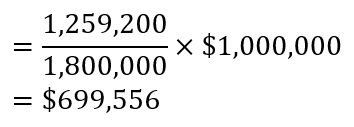

Consistent with the logic of partial disposal, the right-of-use asset represents the portion of the previous carrying amount of the asset retained by the seller / lessee.

Scenario 2 - Sales Proceed Received is Lesser Than Fair Value
Company A sells a building to Company B for cash of $2 million. The fair value of the building is $2.2 million. The carrying amount of the building immediately before the sale is $1 million.  
At the same time, Company A enters into a contract with Company B for the right to use the building for 18 years, with annual payments of $120,000 payable at the end of each year. The interest rate implicit in the lease is 4.5%, which results in a present value of the annual payments of $1,459,200.   
The sale of the building to Company B meets the definition of a sale under IFRS 15.
As noted in the bold sentence above, the sales proceed of $2 million is lower than the fair value of the building of $2.2 million. The difference of $0.2 million will be treated as prepayment of lease payment.

In other words, the sales proceed of $2 million can also be broken down into the following:

1. Company A receives the proceed of $2.2 million when sell the building.
2. Then Company A will pay $0.2 million to the seller / lessor as prepayment.

$2.2 million received minus $0.2 million paid, hence we get $2 million net proceed.

Let's follow through the four (4) steps required for seller / lessee.

Step 1 - Derecognise the Asset

The double entry for derecognition will be as follows:

Dr Bank $2 million
Dr Lease prepayment $0.2 million
Cr PPE $1 million
Cr Gain on disposal $1.2 million

As shown above, the gain on disposal of $1.2 million is calculated as the difference between the fair value of the asset ($2.2 million) and the carrying amount of the asset ($1 million). The difference of $0.2 million is recognised separately as a lease prepayment.

Step 2 - Recognise the Leaseback

Dr Right-of-use Asset $1,659,200
Cr Lease liability $1,459,200
Cr Lease prepayment $200,000

In step 2, when we recognise right-of-use asset, the prepayment of $200,000 will be reclassified to right-of-use asset. According to paragraph 24(b) of IFRS 16, it is mentioned that the cost of the right-of-use asset shall comprise any lease payments made at or before the commencement date (i.e. prepayment).

The lease liability will be recognised at $1,459,200 and right-of-use asset will be the total of $1,459,200 and $200,000.

Step 3 - Calculate the Gain Attributable to Seller / Lessee (Gains Related to Portion Not Transferred to Buyer / Lessor)
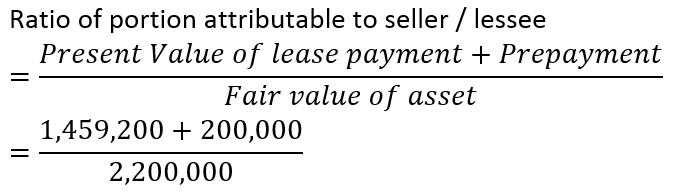


Take note that as we have prepayment of $200,000, we need to include it into the ratio calculation (as shown above). We are comparing $1,659,200 (the lease payment together with prepayment) with the fair value of $2,200,000 (also includes prepayment) so as to achieve apple with apple comparison.

Oops, I am sorry orange, even though both of you are fruits, an apple must still be compared with an apple, so I must politely say, "Please get out!" 😂😂😂

Anyway, the gain attributable to seller / lessee will be as follows:


Step 4 - Remove the Gain Attributable to Seller / Lessee from Total Gain 

Dr Gain on disposal $905,018
Cr Right-of-use asset $905,018

Summary

In summary, below represents the double entry for the sales and leaseback:

Dr Bank $2,000,000
Dr Right-of-use Asset (1,659,200-905,018) $754,182
Cr PPE $1,000,000
Cr Lease liability $1,459,200
Cr Gain on disposal (1,200,000-905,018) $294,982

Alternatively, the right-of-use asset can also be calculated using the following method:

Right of use asset
= Ratio of portion attributable to seller or lessee x Previous carrying amount of the asset

Consistent with the logic of partial disposal, the right-of-use asset represents the portion of the previous carrying amount of the asset retained by the seller / lessee.

Accounting for Buyer / Lessor (Relevant for SBR)

The accounting for buyer / lessor is the same as what I have explained previously in Part 1. You can refer to the explanation there.

Conclusion

Sales and leaseback can be complicated, but if we dissect the steps slowly and follow through the four steps that I have mentioned, I believe you will be able to understand them. As long as you understand the logic behind partial disposal, then you will be able to understand sales and leaseback. Wish you all the best in your studies and everything you do!


Tuesday, 27 August 2019

IFRS 16 - Sales and Leaseback (Part 1)

Sales and leaseback under IFRS 16 Leases can be quite confusing to many students. As such, I hope to make it simpler for you.

Note: This post is suitable for ACCA students who are studying for Financial Reporting (FR) or Strategic Business Reporting (SBR). However, SBR students will need to know the accounting treatments for both lessor and lessee whereas FR students will only need to know the accounting treatments for lessee.

Let's start with clarifying the difference between lessor and lessee:

Lessor - the person who rents out an asset to lessee. Lessor will collect rental income from lessee.

Lessee - the person who uses the rented asset of lessor. Lessee will pay rental income to lessor for the right of use of the leased asset.

Therefore, in a normal leasing scenario, this is what happens:


For sales and leaseback, there are essentially two transactions:

1. Company A (seller) sells the asset to Company B (buyer). Company B will pay Company A for the purchase of asset.


2. Company A will then lease the same asset back from Company B (leaseback). As such, Company A (the seller) is now the lessee whereas Company B (the buyer) is now the lessor. Being a lessee, Company A will pay rental to Company B.


Before we proceed, make sure you understand and remember this:

Seller = Lessee 
Buyer = Lessor

The reason why an entity decides to engage in such transactions is because it is a way to obtain funding. When Company A sell off their asset, Company A will get a lump sum amount from Company B. Thereafter, they just need to pay rental to Company B. As such, from Company A's perspective, Company A will be able to have a better cash flows because they receive one lump sum amount upfront and the future cash outflows are just rental payments.


So now the first important question to be asked is this:
For the first transaction (i.e. the sales from Company A to Company B), is it really a sale or is it just a way for Company A to obtain a loan (i.e. the asset "sold" is just a collateral for the loan)?
I mean obtain a loan, not forever alone!
The reason why this is important is that when we prepare financial statements, we need to reflect substance over form. Our financial statements should "represent faithfully the substance of the phenomena it purports to represent" (conveniently copied and pasted from the 2018 IFRS Conceptual Framework).


I don't know if this is true but thank you for inventing copy and paste!!!😂😂😂

Anyway back to substance over form. The idea is that if it is a sale, then we reflect it as sales in financial statements. If it is not a sale, then it is a loan, so we need to reflect the loan in financial statements.

The next important question that we need to ask is:
How do we determine whether a transaction is a sale?
To answer this question, let's look at what paragraph 99 of IFRS 16 says:
An entity shall apply the requirements for determining when a performance obligation is satisfied in IFRS 15 to determine whether the transfer of an asset is accounted for as a sale of that asset.
Let's look at what IFRS 15 has to say about satisfying a performance obligation (paragraph 31 of IFRS 15):
An entity shall recognise revenue when (or as) the entity satisfies a performance obligation by transferring a promised good or service (i.e. an asset) to a customer. An asset is transferred when (or as) the customer obtains control of that asset.
As such, we can now conclude that a transaction is a sale if Company B obtains control of the asset sold by Company A. If Company B does not obtains control of the asset, then Company B is actually providing a loan to Company A.

Let's elaborate the accounting treatments below:

When The Transaction Is NOT a Sale

So if the first transaction is not a sale, it means that Company A still control the asset and Company B do not have any control of the asset. In substance, Company A is borrowing money from Company B and Company A is providing the asset as collateral (security) for the loan. This is represented in the diagram below:


As there is no sale of asset by Company A, Company A will not derecognise their asset. Instead, Company A will recognise a financial liability (i.e. a loan or liability) under IFRS 9 when they receive the fund.

Dr Bank XX
Cr Financial Liability (Loan Payable) XX

Company B will recognise a financial asset when they provide loan to Company A:

Dr Financial Asset (Loan Receivable) XX
Cr Bank XX

The subsequent "rental" payment made by Company A to Company B is not a rental payment, but it is actually repayment of the loan, as shown below:


So from Company A's point of view, the double entry for such repayment of loan will be something like this:

Dr Financial Liability (Loan Payable) XX
Dr Finance Cost (interest expense in Profit or Loss) XX
Cr Bank XX

For Company B, the double entry when they receive the repayment of the loan will be something like this:

Dr Bank XX
Cr Financial Asset (Loan Receivable) XX
Cr Finance Income (interest income in Profit or Loss) XX

The financial liability of Company A and the financial asset of Company B will be dealt with under IFRS 9 and generally both of them will be accounted for using amortised cost if the criteria under IFRS 9 are fulfilled. 

Note that we will not cover the accounting treatment of IFRS 9 in this post.

When The Transaction IS a Sale

So if the first transaction is a sale, it means that Company A does not control the asset anymore because the control has been transferred to Company B. As such, Company A (seller) should record the sale of asset (i.e. the asset is derecognised and a gain/loss on disposal should be recognised).

However, this is not as straightforward as a normal disposal of asset. This is because in a normal disposal of asset, the seller will transfer 100% of the asset to the buyer. After the sale, the seller will no longer use the asset. In this case, the seller recognises the full (100%) gain or loss on disposal.

But for sales and leaseback, the seller will subsequently leaseback the asset and continue to use the asset. As such, the disposal is not 100% because the seller still has the right to use the asset after the disposal. 

In other words, the seller still retains some of the portion of the asset originally owned (because the seller is still using it after the sales).

As such, in order to faithfully represent the sales and leaseback, because the disposal is not 100%, the seller can only treat the disposal as partial disposal. This means that seller DOES NOT recognise 100% of the gain or loss on disposal. Seller only recognises part of the gain, i.e. recognises the gain or loss for the portion that is transferred to the buyer or lessor.

To make the above points clearer:

1. The gain or loss TO BE recognised in Profit or Loss by the seller is only the portion of the gain or loss that is transferred to the buyer (lessor). In short, we call this portion as gain or loss attributable to the buyer / lessor. 

2. The portion of the gain or loss that is not transferred to the buyer (lessor) is NOT recognised by the seller. In short, we call this portion gain or loss attributable to the seller / lessee (Note: attributable to seller / lessee as it represents the portion not transferred to buyer. Not transferred means still belong to seller, hence attributable to seller).

This can be represented using the diagram below:


Let's use an example to illustrate the above:
Company A sells a building to Company B for cash of $2 million. The fair value of the building is equal to the cash consideration of $2 million. The carrying amount of the building immediately before the sale is $1 million. 
At the same time, Company A enters into a contract with Company B for the right to use the building for 18 years, with annual payments of $120,000 payable at the end of each year. The interest rate implicit in the lease is 4.5%, which results in a present value of the annual payments of $1,459,200. 
The sale of the building to Company B meets the definition of a sale under IFRS 15.
Company A sells building to Company B at $2 million

Company A leases back the building and pay annual rental of $120,000 to Company B.
Solutions

As the transactions is a sale, we shall account for it as a sale. 

Seller / Lessee Accounting

In general, there are four (4) steps to be followed for a sale and leaseback scenario if we are performing the accounting for seller / lessee.

Step 1 - Derecognise the Asset

The first step is to account for the sale of the building. In other words, the building will be derecognised and a gain or loss is recognised. 

Note: For Step 1, we will treat the derecognition as if it is a full disposal (i.e. to treat the derecognition normally) for now. We will adjust for partial disposal later on in Step 3 and 4.

Dr Bank $2m
Cr PPE $1m
Cr Gain on disposal $1m

As shown in the double entry above, the gain on disposal is $1 million. However, this represents the total gain of disposal. As we can only recognise the gain attributable to the buyer / lessor, we will need to remove the gain attributable to seller / lessee from the total gain (this will be shown in Step 3 and 4 later).

Step 2 - Recognise the Leaseback

The second step is to recognise the leaseback of the building from Company B. According to IFRS 16, the lessee shall recognise a right-of-use asset and a lease liability based on the present value of the lease payment ($1,459,200).

Dr Right-of-use asset $1,459,200
Cr Lease liability $1,459,200

Step 3 - Calculate the Gain Attributable to Seller / Lessee (Portion of Gain Not Transferred to Buyer / Lessor)

Now we will need to calculate the gain which is attributable to Company A (the seller / lessee). In other words, we are now calculating the portion of the gain not transferred to the buyer / lessor. Remember that portion of gain not transferred to buyer / lessor cannot be recognised in Profit or Loss. As we have recognised 100% gain in Step 1, we shall remove the gain calculated in this step from the total gain at a later stage in step 4.

Based on the question, the present value of lease payment is $1,459,200. This represents the present value of the lease payment that Company A is required to pay in the future. In other words, this value belongs to Company A (seller / lessee).

As such, we can come out with a ratio as follows:


In other words, Company A will pay a present value of $1,459,200 for the asset and this is 72.96% of the total fair value of asset. We can therefore say that Company A is using 72.96% of the asset. 

As such, we cannot recognise 72.96% of the gain because 72.96% of the gain is attributable to Company A - the seller / lessee. We can only recognise the remaining 27.04% of the gain (i.e. gain that is attributable to the buyer / lessor - Company B).

We shall use this ratio to multiply with the total gain on disposal of $1 million in order to find the gain attributable to seller / lessee:


After this calculation, we can move into Step 4.

Step 4 - Remove the Gain Calculated in Step 3 from Total Gain Calculated in Step 1

In this step, we remove the gain by debiting gain on disposal. The corresponding adjustment is made to the right-of-use asset.

Dr Gain on disposal $729,600
Cr Right-of-use asset $729,600

In order words, from the total gain of $1 million, we have removed the gain attributable to seller / lessee of $729,600. What is left behind is the gain attributable to buyer / lessor, which is $270,400, as shown below:


That's all for the adjustment for sales and leaseback.

Summary

Below represents the summary of all the double entries from Step 1 to Step 4

Dr Bank $2,000,000
Dr Right-of-use Asset (1,459,200-729,600) $729,600
Cr PPE $1,000,000
Cr Lease Liability $1,459,200
Cr Gain on disposal (1,000,000-729,600) $270,400*

* Gain attributable to buyer / lessor

Subsequently, the requirement of lessee under IFRS 16 will be applied.

Note: The value of the right-of-use asset as shown above ($729,600) can also be calculated using the following method:

Right of use asset
= Ratio of portion attributable to seller or lessee x Previous carrying amount of the asset

Applying the same logic of partial disposal, the right-of-use asset represents the portion of the previous carrying amount of the asset retained by the seller / lessee (i.e. 72.96% of $1,000,000).

Buyer / Lessor Accounting (Relevant for SBR only)

As Company B (buyer / lessor) obtains control of the building, Company B will recognise the asset.

Dr Investment Property $2 million
Cr Bank $2 million

As Company B obtains a property which will be rented out to Company A, Company B has obtained an investment property under IAS 40.

Note: If the leased asset is a plant and machinery, then the buyer / lessor would have acquired property, plant and equipment (PPE) under IAS 16.

The subsequent lease to Company A would depend on whether it is a finance lease or operating lease. The requirement of lessor under IFRS 16 will be applied from this point onwards (which will not be covered in details in this post).

Generally, if the lease to Company A qualifies as finance lease, then the investment property will be derecognised and a financial asset will be recognised (this financial asset is also known as net investment in lease). Finance income will be recognised and any payment received from Company A will reduce the net investment in lease.

If the lease to Company A qualifies as operating lease, then the investment property will not be derecognised. Instead, Company B will recognise the rental income received from Company A on a straight line basis. Generally, the investment property will be measured using fair value model under IAS 40, with the changes in fair value reflected in the Profit or Loss. If the leased asset is PPE, then it will be held under cost model or revaluation model under IAS 16.

Hope that you will find the above illustrations useful!

I will write about the case for sales and leaseback in which the selling price is not equal to the fair value of the asset transferred in Part 2. Stay tuned!

Monday, 19 August 2019

IAS 24 Related Party Disclosures - Part 2


It's time to continue with Part 2 of IAS 24! (If you have not read Part 1, this is the link: https://tysonspeaks.blogspot.com/2019/08/ias-24-related-party-disclosures-part-1.html)

As a recap, under Paragraph 9 of IAS 24, part (a) of the definition deals with a person (i.e. when a person / real human being is related to an entity) and part (b) deals with an entity (i.e. when an entity is related to another entity). This post will focus on part (b) of the definition.

Let's look into Part (b)(i).

An entity is related to a reporting entity if the entity and the reporting entity are members of the same group (which means that each parent, subsidiary and fellow subsidiary is related to the others).


The diagram above shows a group of company (parent with two subsidiaries and one sub-subsidiaries). All the four companies above are related to each other as they are in the same group.

Note: Subsidiary is a company that is controlled by the parent.

Part (b)(i) is quite simple. Let's look at Part (b)(ii) now.

An entity is related to a reporting entity one entity is an associate or joint venture of the other entity (or an associate or joint venture of a member of a group of which the other entity is a member).

According to IAS 28,
An associate is an entity over which the investor has significant influence.
According to IFRS 11,
A joint venture is a joint arrangement whereby the parties that have joint control of the arrangement have rights to the net assets of the arrangement. Those parties are called joint venturers.
There are a few possible scenarios under part (b)(ii):

Scenario 1 - Associate or Joint Venture of the Other Entity

Generally, if a company is having an associate or joint venture, they are considered related (as shown below).


However, take note that the parent and Co A are not necessarily related party. More information are needed to assess whether they are related party.

Note: The associate and the joint venture are also related based on paragraph 9(b)(iv), which will be covered later.

Scenario 2 - A Group with Subsidiary, Sub-subsidiary, Associate and Joint Ventures

Let's now make some changes to the group structure in Scenario 1. Assuming that the parent is also having a subsidiary and sub-subsidiary as shown in the diagram below:


1. The parent, subsidiary and sub-subsidiary are in the same group. As such, they are related to each other.


2. As the parent also owns the associate and joint venture and the parent is in the same group with subsidiary and sub-subsidiary, the associate and the joint venture are also related to the subsidiary and sub-subsidiary.


Scenario 3 - Associate or Joint Venture of Subsidiary

Consider the following scenario:


1. The parent, subsidiary A and subsidiary B are in the same group. As such, the three companies are related to each other.

2. The associate or joint venture is related to Subsidiary A due to associate or joint venture relationship.

3. As subsidiary A is part of the group with Parent and Subsidiary B, the associate or joint venture is also related to parent and subsidiary B.

Scenario 4 - Associate's Subsidiary or Joint Venture's Subsidiary

IAS 24 also mentions that:
An associate includes subsidiaries of the associate and a joint venture includes subsidiaries of the joint venture. Therefore, for example, an associate’s subsidiary and the investor that has significant influence over the associate are related to each other.

As shown above, the parent is related to the subsidiary of the associate or joint venture.

That's all for Part (b)(ii). We can now look into Part (b)(iii).

An entity is related to a reporting entity if both entities are joint ventures of the same third party.

Consider the following scenario:


Joint Venture 1 and Joint Venture 2 are both jointly owned by Co A and Co B. As such, Joint Venture 1 and Joint Venture 2 are related.

However, take note that the Co A and Co B are not necessarily related party. More information are needed to assess whether they are related party.

Let's now look into Part (b)(iv).

An entity is related to a reporting entity if one entity is a joint venture of a third entity and the other entity is an associate of the third entity

For this part, we will refer back to Scenario 1 in part (b)(ii) above.


Refer to the purple arrow above, the associate and joint venture are related because they relate to the same company (i.e. the parent).

However, two associates of the parent are not related party (as shown below):


This is because common significant influence is not sufficiently strong to create a related party relationship. In other words, if you can only somehow influence the associates, you can't really have a strong power to force the two associates to be involved in certain transactions.

We can now look into Part (b)(v).

An entity is related to a reporting entity if the entity is a post‑employment benefit plan for the benefit of employees of either the reporting entity or an entity related to the reporting entity. If the reporting entity is itself such a plan, the sponsoring employers are also related to the reporting entity. 

This paragraph deals with a post-employment benefit plan under IAS 19. Basically, the defined benefit plans are related to the company or related entities of the company.


Next, let's look at Part (b)(vi) and Part (b)(vii) together.

An entity is related to a reporting entity if the entity is controlled or jointly controlled by a person identified in (a).

An entity is related to a reporting entity if a person identified in (a)(i) has significant influence over the entity or is a member of the key management personnel of the entity (or of a parent of the entity).

As a recap, part (a) of the definition talks about:
A person or a close member of that person’s family is related to a reporting entity if that person:  
(i) has control or joint control of the reporting entity;  
(ii) has significant influence over the reporting entity; or  
(iii) is a member of the key management personnel of the reporting entity or of a parent of the reporting entity. 
 As such, there are a few possible scenario under part (b)(vi) and part (b)(vii).

Scenario 1


When a person is having controls or joint controls over two entities, then the two entities are related.

Scenario 2

Let's change scenario 1 a bit by bringing in the close member of that person's family (i.e. the wife now appears!).


In this case, the two entities are also related to each other.

Scenario 3

Now let's look at the case where a person and his close family member jointly controls two entities.


In this case, the two entities are also related to each other.

Scenario 4

Let's look into the scenarios where a person has control or joint control over one entity and that person (or his close family member) has significant influence or is a key management personnel of the another entity.


or


For the two cases above, Co A and Co B are related to each other.

Scenario 5

For this scenario, we have one person who is having control or joint control over one entity (Co A) and that person (or his close family member) is the key management personnel of the parent (Co B) of the other entity (Co C).

or


In these cases, Co A and Co B are related. As Co B can also controls Co C, we can therefore say that Co A is also related to Co C.

Scenario 6

However, do take note that if one person is having significant influence over one entity and he (or his close family member) is also having significant influence over another entity, the two entities are not related, as shown below.

or


As mentioned previously, this is because common significant influence is not sufficiently strong to create a related party relationship.

Scenario 7

You should also take note that if two entities are having common director or common key management personnel, the two entities are not necessarily related party, as shown below:


Whether or not Co A and Co B are related would depend on whether the person has the power to control both companies or not.

Scenario 8

Same goes to the case where a person is a key management personnel of a entity and that person have significant influence over another entity, the two entities are also not related party, as shown below:

Finally, we can now look at the last point of the definition, part (b)(viii).

An entity is related to a reporting entity if the entity, or any member of a group of which it is a part, provides key management personnel services to the reporting entity or to the parent of the reporting entity.

Sometimes, an entity might be outsourcing their management services to a management company. This management company provides key management service to the entity. Such management company is considered related to the entity (as shown below, the management company is related to the parent).


If the management company provides key management personnel service to the parent of the subsidiary, the subsidiary is also considered as related to the management company.


Phew! Finally we come to an end of the definition! What a longgggggg post.

As a final note, I think I should highlight you on the scenarios where two entities are not related party according to paragraph 11 of IAS 24:

(a)

two entities simply because they have a director or other member of key management personnel in common or because a member of key management personnel of one entity has significant influence over the other entity. (highlighted in Scenario 7 and 8 of Part (b)(vi) and Part (b)(vii) above)

(b)

two joint venturers simply because they share joint control of a joint venture. (highlighted in Part (b)(iii) above)

(c)

(i) providers of finance,
(ii) trade unions,
(iii) public utilities, and
(iv) departments and agencies of a government that does not control, jointly control or significant influence the reporting entity, simply by virtue of their normal dealings with an entity (even though they may affect the freedom of action of an entity or participate in its decision‑making process).

(d) a customer, supplier, franchisor, distributor or general agent with whom an entity transacts a significant volume of business, simply by virtue of the resulting economic dependence.


Congratulations! You have reached the end of the post!

Wishing you have a nice day ahead of you and hope that you learnt something from these posts!